
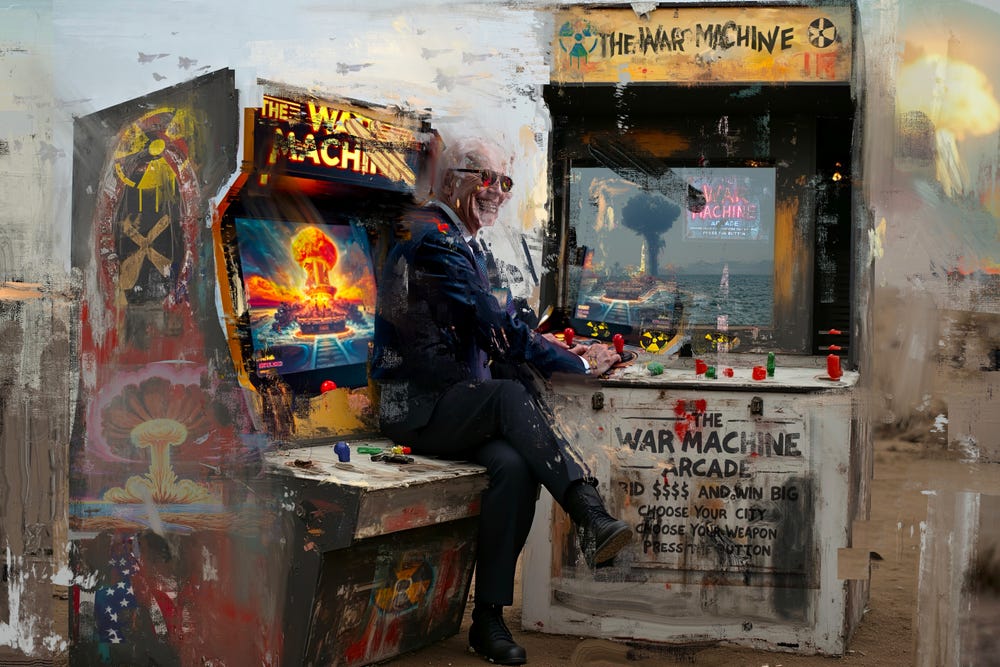
Arcade Joe — by Norman Harman (@NorrieHarman)
In January 2024, the International Court of Justice found it plausible that Israel was committing genocide in Gaza and ordered provisional measures under the Genocide Convention. The ruling changed nothing. Now, one year later, Israel has killed more than 50,000 Palestinians and erased entire cities. Israel’s genocide continues; its siege of Gaza holds. In parliaments, international forums, and media studios throughout the Western world, Palestinians are still being pressed to denounce Operation Al-Aqsa Flood with undiminished urgency, as though the ICJ had ruled on some other matter entirely. The international order has never existed to protect Palestine; it has always been the guarantor of its dispossession.
Within that order, Palestinian suffering generates demands for Palestinian accountability; Israeli colonial violence generates demands for Palestinian restraint. Palestinian resistance is cast as terrorism, irrational violence, or hatred of Jews—so that the settler-colonial project can advance while its violence goes unquestioned.
Malcolm X saw it plainly after visiting the Khan Younis refugee camp in Gaza in 1964: “The problem that exists in Palestine is not a religious problem. It is a question of colonialism. It is a question of a people who are being deprived of their homeland.” While Israel suppresses that truth, its expansion continues unimpeded: more land is seized, more settlements are built, more Palestinians are displaced, more communities are fragmented, each new fact on the ground is made harder to reverse.
The historical record is unambiguous. In 1948, Israel expelled 750,000 Palestinians, destroyed 530 of their villages, and established a Jewish state on their ancestral land—then recast the conquest and expulsion as a defensive war against Arab aggression. The story that took hold was of a small, valiant, besieged Western Jewish population fighting for survival against a vast, undifferentiated Arab mass bent on its destruction. The victory was real. The lie was that Israel had fought a defensive war against an overwhelming Arab force.
Plan Dalet, a Haganah blueprint drawn up in March 1948, called for the depopulation of Palestinian villages and the seizure of territory beyond the UN partition boundaries. It was activated in April 1948, a month before Israel declared statehood and before a single Arab army entered Palestine. By May 15, 1948, when the Arab armies intervened, more than 250,000 Palestinians had already been driven out. By then, the expulsion was well underway, and Zionist forces had begun seizing territory that had been assigned by the UN partition plan to the Arab state of Palestine.
The Arab armies were not the overwhelming force depicted in the mythology that followed. By early 1949, Zionist forces, armed with far superior European weaponry, had grown to 115,000 troops—more than twice the combined strength of the Arab armies. The most effective Arab force, the Arab Legion, was not a force of liberation, but a British colonial instrument commanded by the British officer John Bagot Glubb. It operated primarily within territory the UN had assigned to the Arab state, even as Zionist forces seized parts of that territory.
Israeli aggression recast as a defensive response became a recurring template. In 1956, in response to Egyptian President Gamal Abdel Nasser’s nationalization of the Suez Canal, Britain, France, and Israel concluded the secret Protocol of Sèvres outside Paris. Under its terms, Israel would attack Egypt, providing Britain and France with a pretext to intervene in the conflict.
In 1967, Israel again attacked Egypt first, destroying the Egyptian air force on the ground and seizing the Sinai Peninsula, Gaza, the West Bank, East Jerusalem, and the Golan Heights in six days. Fifteen years later, in an address to the Israeli National Defense College, Prime Minister Menachem Begin conceded that Israel had initiated the war: “We must be honest with ourselves. We decided to attack.” Again, an attack initiated by Israel was recast as a defensive necessity; in both cases, war produced territorial expansion for the settler-colonial project.
For the first twenty-five years after Israel’s founding, no Arab country had initiated a war with Israel. That changed on October 6, 1973, when Egypt and Syria launched a coordinated offensive to recover the territories Israel had seized in 1967. The United States intervened, airlifting more than 22,000 tons of weapons and supplies to Israel over thirty-two days. Britain had sponsored the settler-colonial project through 1948; by 1973, the United States had replaced Britain as the imperial guarantor of Israel’s survival.
The 1978 Camp David Accords were the most significant diplomatic achievement to emerge from that guarantee. Brokered by US President Jimmy Carter, they provided for the return of Sinai to Egypt in exchange for Egyptian recognition of Israel. The Palestinians were not party to the agreement. Their land, their rights, and their future were negotiated without them, confined to a framework of limited autonomy that offered neither sovereignty nor statehood.
The Oslo Accords between Israel and the Palestine Liberation Organization were supposed to deliver Palestinian self-determination. When they were signed in 1993, approximately 264,000 Israeli settlers lived in the West Bank and East Jerusalem. By the end of 2023, that number had risen to more than 746,000. While Palestinians were required to renounce armed resistance as the price of recognition, Israel nearly tripled the settler population. Settlement expansion has never stopped.
Israel has maintained a siege of Gaza’s 2 million inhabitants since sealing the territory in 2007. In 2018 and 2019, Palestinians in Gaza marched unarmed toward the Israeli-imposed perimeter fence in what they called the Great March of Return. Over seventy weeks, Israeli snipers killed over 200 of them. The protests ended; the siege did not.
October 7, 2023 was the consequence of the siege, fragmentation, and dispossession imposed by Israel and permitted by the international community. When Hamas inflicted a military defeat that day, Israel reached for the same inversion it had used since 1948, detaching Palestinian resistance from the colonial conditions that produced it and recasting Israel’s aggression as self-defense.
Israel buried that defeat beneath an atrocity narrative. Western governments and media amplified unverified claims of mass rape and beheaded babies and used them to foreclose scrutiny of what followed. Those claims remain unsubstantiated. Fifteen months after October 7, Moran Gez, an Israeli prosecutor handling cases arising from that day, admitted: “In the end, we have no complainants.” The overwhelming majority of rape allegations, she acknowledged, could not meet the threshold of proof in court. The UN team that examined thousands of photographs and videos provided by Israel found “no tangible indications of rape” in the material. The beheaded-babies claim originated with ZAKA, an Israeli organization whose leaders were caught fabricating atrocity propaganda.
The facts changed nothing. Long after the claims had been discredited, they continued to be cited in parliaments, incorporated into legal submissions, and repeated on news channels. The demand for Palestinian condemnation does not require truth. It requires consensus. And repetition produces that consensus more reliably than evidence ever could.
Under that cover, the pattern resumed. Israeli cabinet ministers announced plans to reestablish Israeli settlements in Gaza. Israel has killed more than 50,000 Palestinians, displaced nearly the entire population of Gaza, engineered famine, and destroyed hospitals, universities, and other civilian infrastructure. Israel’s genocidal campaign is not a reaction to October 7; it continues the settler-colonial project Israel has advanced over decades through siege, fragmentation, repeated mass killing, and expulsion.
Across every phase, the settler-colonial project has followed the same logic: the expulsion of 750,000 Palestinians in 1948, the near tripling of the settler population while Palestinians were required to renounce armed resistance, the siege of Gaza since 2007, and the killing of unarmed marchers at a fence. Before any evidence is heard, Palestinians are required to answer for their resistance so that Israel can act without restraint, and without ever having to answer for what it has done.

This essay was first published in January 2025. The casualty figures reflect what was known at the time of publication. Footnotes have been updated to reflect subsequent reporting and investigations.
The unsubstantiated nature of the October 7 atrocity claims is documented in detail by The Electronic Intifada. On the rape narrative: Ali Abunimah, “Israel still can’t find any 7 October rape victims, prosecutor admits,” The Electronic Intifada, January 6, 2025; Ali Abunimah, “Israeli rights group admits it helped spread false claims about 7 Oct. rapes,” The Electronic Intifada, May 19, 2024, citing the findings of the UN team led by Special Representative Pramila Patten, which examined thousands of photographs and videos provided by Israel and found no tangible indications of rape. On the beheaded-babies claim and the ongoing rape narrative, The Electronic Intifada has documented extensively that these claims originated with ZAKA, an Israeli organization whose leaders were caught fabricating atrocity propaganda; see the publication’s 7 October investigations archive. For the most recent comprehensive investigation, see Ali Abunimah, “Israel’s 7 October rape hoax gets a 300-page reboot,” The Electronic Intifada, May 14, 2026. For the foundational ZAKA exposé, see Max Blumenthal, “Scandal-stained Israeli ‘rescue’ group fuels October 7 fabrications,” The Grayzone, December 6, 2023.
The world is waking up.
The truth is being seen.
The sun will not stay behind the clouds and Gaza is not alone.
The contrast you draw between Palestinian suffering being met with demands for restraint, while the violence that produced it is often treated as the background, is hard to ignore. The historical context matters and so does the question of who gets held accountable. 🇵🇸