
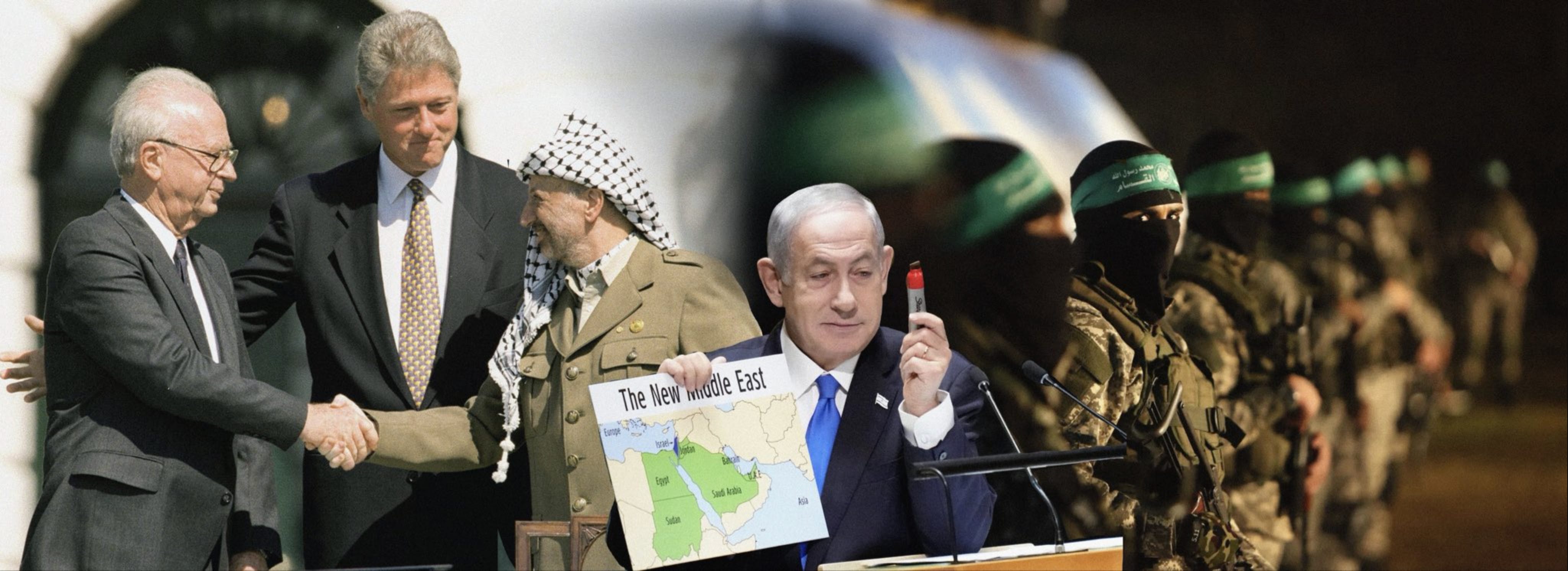
In September 1993, the world was asked to believe that the Palestinian struggle had ended with the Oslo Accords. Signed by Israel and the Palestine Liberation Organization (PLO) after the First Intifada, the Oslo Accords were presented by their sponsors as the beginning of peace and coexistence. The Intifada—the popular uprising that swept the occupied West Bank and Gaza from 1987—had transformed the Palestinian struggle into a global cause. Through mass protest, strikes, and civil disobedience, it forced the world to confront the legitimacy of Palestinian demands. As pressure mounted, Israel and the United States opened a diplomatic track designed to contain the uprising rather than address its causes.
The same track had run through the 1991 Madrid Conference, where the official Palestinian delegation, drawn from the occupied territories and led by Haidar Abdel-Shafi of Gaza, negotiated publicly and refused the terms on the table. Israel and the United States found a willing counterpart in Yasser Arafat and the PLO, exiled in Tunis after Israel’s 1982 invasion of Lebanon drove them from Beirut. Detached from the movement inside Palestine and estranged from those it claimed to represent, Arafat’s leadership entered secret negotiations in Oslo, in a back channel that undermined the Palestinians’ own delegation.
Arafat and a handful of PLO subordinates faced a corps of Israeli Foreign Ministry experts in law and diplomacy. They negotiated in English, a language they barely knew, and with no legal counsel. What followed was a capitulation: unilateral concessions that entrenched Israel’s control over borders, resources, and security, transforming occupation into a system of managed Palestinian autonomy. Within weeks of the signing, the Palestinian intellectual Edward Said wrote, “Let us call the agreement by its real name: an instrument of Palestinian surrender, a Palestinian Versailles.”
Arafat’s recognition of Israel’s “right to exist” carried with it renunciations of the PLO Charter, of armed struggle, and of UN resolutions affirming the Palestinians’ right of return. The surrender alienated many Palestinians, especially in Gaza, where nearly three-quarters of the population are refugees or their descendants. The people whose return to the homes from which they were expelled in 1948 had just been signed away. Israel conceded nothing, offering only a token acknowledgment of the PLO as the representative of the Palestinian people.
The Palestinian Authority—Oslo’s own creation—became the occupier’s subcontractor: administering the occupation Israel no longer wished to manage alone, dependent on foreign aid, constrained by Israeli approval, accountable not to its people but to its patrons. The Oslo Accords made Israeli security the organizing principle of Palestinian governance—an assurance granted even as Israeli violations of Palestinian security went unchecked.
Everything the First Intifada had won was thus undone—half a century of struggle and sacrifice buried beneath a “peace process” that redefined occupation as “self-rule” and subjugation as “compromise.”
For the Arab states, the Oslo Accords established the rule: progress and stability could be achieved only through collaboration with Israel, guaranteed by US power. Over time that rule hardened into a sense of inevitability—the conviction that history had concluded and liberation with it, and that the United States alone defined the terms of progress and decline. Across the Arab world, voices that had once spoken the language of liberation began to echo the rhetoric of pragmatism, presenting accommodation as realism and dependence as reform. Resistance gave way to reliance, and the collective will to struggle was slowly extinguished.
Bound by their dependence on U.S. economic and political support, Arab governments signed treaties and normalization deals that aligned them with the very order they had opposed. Shared security frameworks, surveillance cooperation, and trade corridors integrated them into a colonial system organized around Israeli supremacy.
Unlike earlier peace efforts that had at least gestured toward Palestinian inclusion, the 2020 Abraham Accords abandoned even the pretense of it. Brokered by Washington to establish formal relations between Israel and Arab states, they bypassed Palestinians entirely, offering no remedy for occupation, settlements, or refugees. Repatriation and compensation went unmentioned; both had long been dismissed as impossible.
The normalization project reached its zenith at the UN General Assembly in September 2023, when Netanyahu unveiled a map of a “New Middle East”: a vision of regional integration from which Palestine had been erased. The map was a boast; the project declared all but complete. For three decades, the illusion that stability could be built on the abandonment and erasure of Palestine had defined the regional order. It ended on October 7.
In October 1993, Said had laid out the whole case in “The Morning After,” his response to the Oslo Accords in the London Review of Books. Self-determination, he wrote, “has a meaning only if freedom, sovereignty and equality, rather than perpetual subservience to Israel, are its goal.” Thirty years later, the illusion he exposed collapsed. The moral and political language of resistance he kept alive now defines the region’s horizon. The struggle he saw slipping away has returned to the center of political life.
As Oslo’s illusion gave way, so too did Israel’s, each sustained by the same fiction of peace through domination. The myth of the fortress died on October 7—the army that never fails, the intelligence that never sleeps. A settler society built on the promise of security and leisure saw both fail in a single morning.
The shock drove that society back to the foundational logic of Zionism: the settler-colonial ambition to reorder the land by expelling its native people, to make permanence out of ethnic cleansing. The wound would be healed by war, deterrence restored by destruction. The resistance in Gaza would be wiped out, its population expelled and scattered. Two years later, with unconditional U.S. military, diplomatic, and ideological support, Israel has achieved none of it: Hamas has not been destroyed, the people of Gaza—displaced again and again—have not been expelled, the captives were released through the negotiation Netanyahu had refused, and the “total victory” he vowed has eluded him.
The war has left Israel more isolated than at any point in its history. Its image, long curated by Western media and political patronage, has collapsed; the distortions that once inverted victims and aggressors no longer conceal what the world has seen. Gone is the legitimacy of a state that has made permanent war its only language.
The genocide is being broadcast, and the broadcast has globalized the Palestinian question. What empire controlled through narrative, it now confronts through exposure. Images have outrun censorship and created solidarity across borders; many of those images have been filmed by Israeli soldiers themselves. The oppression of one people has revealed the structure of domination that governs all. Across continents and movements, Palestine has ceased to be one cause among others—it has become the measure of justice itself.
What October 7 restored, amid the devastation of Gaza, was not victory but vision. For a generation, freedom had meant what the occupier would permit. Palestinians around the world can once again see it whole—an idea, a moral claim, a spiritual horizon. That vision reclaims the terrain of imagination and meaning, the ground colonialism works hardest to occupy. To see freedom is to act toward it: to rebuild what is broken, to organize what is scattered, to give form to a future no longer defined by conditions set or denied by others.
Three decades after “The Morning After,” Said’s warning has turned inside out. A generation that inherited the ruins of Oslo has rejected the logic of its defeat. It was the discipline he had taught all along. “To every situation,” he said in conversation the year after the Accords, “there’s always an alternative. What one must train oneself is to think the alternative, and not to think the accepted and the status quo or to believe that the present is frozen.” The collapse of illusion has become the recovery of history—a people who once fought to be seen are again shaping how the world sees. The struggle is not finished, but its direction is clear—and, for the first time since the First Intifada, that direction belongs to the Palestinians.
(This article follows Part I, “Trump’s Gaza Plan and the Pacification of a People,” which examined the ongoing effort to re-engineer “peace” into an evolving system of colonial control in Gaza.)

“… began as a collapse of illusion has become the recovery of history itself—a people who once fought to be seen are again shaping how the world sees. The struggle is not finished, but its direction is clear—and, for the first time since the First Intifada, that direction belongs to the Palestinians…”
Fantastic writing, Abu Alya! Absolutely grateful you share your writings.
Admire how you always seem to choose the most precise word to communicate a complex idea.
Thank you :)
History doesn’t end under occupation , it waits to be reclaimed.
Reading this felt like watching a people rise from the weight of decades, breaking the silence of a false peace, and reminding the world that even in devastation, the spirit of freedom still breathes.
Thank you Abu Alya for sharing the truth.