
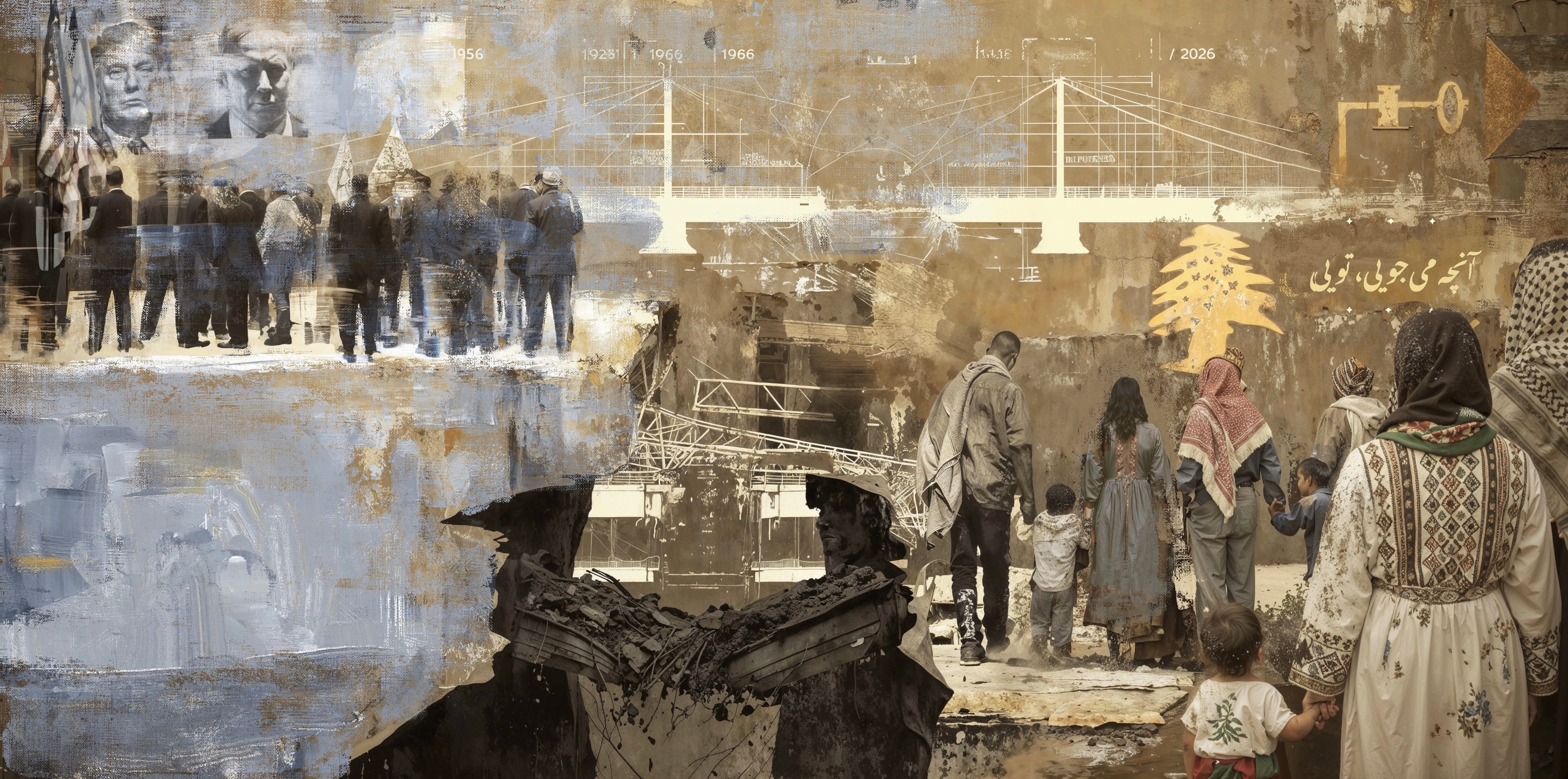
In 1956, at a French villa in Sèvres, Israel’s first prime minister, David Ben-Gurion, outlined what he called a “fantastic” plan. The Muslim population of southern Lebanon was, in his telling, a problem with a solution. Israel would take the south; what remained of Lebanon would be remade. “It would be possible to establish a Christian state there,” he said, “and the southern border of Lebanon should be the Litani River.”
Britain and France had convened Sèvres over Gamal Abdel Nasser’s nationalization of the Suez Canal—the occasion for a war against Egypt. The canal, closed to Israeli shipping, provided one pretext for Israel to enter that war. The fedayeen in Gaza—Palestinian fighters crossing back into the lands from which they had been driven in 1948, raiding the settlements built on their confiscated land—provided another. But beyond its stated aims, the Suez war gave Ben-Gurion his opening to advance Israel’s expansionist agenda.
Beneath both pretexts ran Israel’s strategic objective: to weaken Egypt before its military power consolidated; to expand Israeli territorial control through Gaza and the Sinai—the land bridge to the canal—under cover of a jointly orchestrated operation; and to complete in Gaza what 1948 had left unfinished. The Protocol of Sèvres formalized the agreement: a colonial document in which three powers arranged a region that belonged to none of them, the military operation planned in advance, its public justifications assembled to follow. Among those made refugees by the invasion it authorized was my father, expelled from Gaza in a war Western histories describe as an Israeli act of defense.
Seventy years later, in 2026, Ben-Gurion’s words resurfaced. As Israeli forces destroyed every bridge over the Litani River and displaced more than a million Lebanese, Defense Minister Israel Katz declared that “all houses in villages near the border in Lebanon will be destroyed—according to the model of Rafah and Beit Hanoun in Gaza.” The return of more than 600,000 residents south of the Litani, he added, “will be completely prohibited.” Finance Minister Bezalel Smotrich went further still: “The new Israeli border must be the Litani.” These were Ben-Gurion’s words, restated with the confidence of an imperial order that has never needed to conceal itself. It requires only that those it most threatens mistake each new pretext—the canal, the fedayeen, Hizb-Allah—for the cause of what is being done to them.
In Lebanon, the Maronite right, a political formation more than a century in the making, gave that confusion its most complete articulation. It took shape under the French Mandate with a self-conception as a Western, Christian presence in an Arab-Muslim region—France its enabling condition, the Crusades its usable past. Pierre Gemayel founded the Phalange, its most explicit political expression, after attending the 1936 Berlin Olympics, modeling it openly on the European fascist movements he had observed there. Michel Chiha gave it its intellectual coherence—the principal ideologist of an independent Lebanon, who argued that Lebanon was Phoenician and Mediterranean, a civilization apart from the Arab world that surrounded it. It produced a political culture oriented toward Europe and America as something deeper than patronage—an identity, a Christian, Phoenician, Mediterranean Lebanon emphatically not Arab, not Muslim, and not bound by the fate of the region that surrounded it. That dream—”Western Lebanon,” neutral, prosperous, facing Paris and Washington with its back to the Arab world—has never entirely dissolved.
It persists today in the structural ties of the Lebanese bourgeoisie—Maronite at its core, but extending into the Sunni merchant class—to the West: the American University, the French schools, the emigration networks in Paris, São Paulo, Detroit, Los Angeles. Their economic life runs through Western financial systems, and that same order defines their cultural self-conception. Hizb-Allah represents, for this class, a civilizational affront to what they have always insisted Lebanon must be.
From this political culture came, with a terrible internal logic, the military alliance with Israel. By the 1970s, the Palestine Liberation Organization, under Yasser Arafat’s leadership, had built a state within a state with its own military infrastructure, political institutions, and popular mobilization among Lebanon’s Shia and poor Sunni populations. Its presence tilted the civil war’s balance toward the Lebanese left and its allies and threatened Maronite political dominance at every level: military, structural, demographic. The Maronite right experienced this as a civilizational threat—to their dominance, their dream, their Lebanon—and invited Israel in. Israel under Menachem Begin and Ariel Sharon wanted the PLO’s military capacity destroyed and a friendly Maronite government installed. Pierre Gemayel’s son Bashir was their candidate—the man who would sign the peace treaty that would have detached Lebanon from the Arab front against Israel. Each needed the other to achieve what neither could alone.
The project culminated in 1982. Israel invaded Lebanon, and Gemayel was elected president-elect under its military occupation. When he refused to sign the peace treaty, he was assassinated days before he took office. Israel expelled the PLO from Lebanon, driving them into exile in Tunis. Eighteen years of Israeli occupation followed. The Maronite right turned the consequences of the invasion it had invited into a narrative in which it cast itself as the victim of foreign presences that had dragged it into conflicts not of its making.
After Rafik Hariri’s assassination in 2005, that narrative hardened into ideology. “Lebanon First”—the slogan of the March 14 coalition and its successors—captured a real political claim: that the decisions about when Lebanon goes to war, and at what cost, had long been made by Palestinian, Syrian, and Iranian armed presences on its soil rather than by the Lebanese state. A more immediate condition compounded it: Hizb-Allah had built a parallel state, with its own economy, its own institutions, its own courts, and a consistent willingness to obstruct governments that did not serve its interests. In this ideology, Hizb-Allah—the resistance movement the occupation generated—is the narrative’s primary exhibit, the sole impediment to Lebanese sovereignty.
Within that sovereignty claim, Hizb-Allah’s weapons become the source of Lebanese suffering while the sustained Israeli policy of keeping Lebanon weak, fragmented, and unable to threaten the occupation of Palestine goes unnamed. Every Israeli war on Lebanon becomes a consequence of Hizb-Allah’s “adventurism.” Each devastation—the assassinations, the 2006 war, the wars of 2024 and 2026—becomes, in this account, the price Lebanon pays for Iranian influence rather than Israeli expansionist designs.
The reading’s power is its sincerity. Those who hold it have internalized the colonial definition of the threat until they experience it as common sense, as realism, as love of country—and act on it accordingly. Since 2024, Israel’s war on Lebanon has made the implication explicit: once Hizb-Allah is named as the source of Lebanon’s destruction, Israel’s campaign to destroy it becomes, in structural terms, a campaign on Lebanon’s behalf. It is an alignment the Maronite right never states outright but has sustained consistently—nowhere more so than in the demand for Hizb-Allah’s disarmament during the Israeli military campaign prosecuting the same objective.
Their fantasy is that, after Hizb-Allah is destroyed, Lebanon emerges liberated, sovereign, finally free to become the Western-oriented state it was constituted to be. The fantasy holds only if the historical record goes unexamined. The 1982 invasion, carried out under American guarantees, produced eighteen years of occupation—and the resistance movement that ended it. That movement, Hizb-Allah, is the very one whose elimination is now being sought. Oded Yinon, a senior Israeli Foreign Ministry official, proposed—also in 1982—the fragmentation of Lebanon along sectarian lines as an explicit strategic objective. Ben-Gurion had outlined the same objective at Sèvres in 1956. The American-Israeli design has never been obscure. And yet, after two and a half years of watching Israel’s genocide in Gaza unfold, of watching the wars it has justified, the annexation of the West Bank and the laws passed in the Israeli Knesset to execute Palestinians, some of us have drawn the opposite conclusion about who the enemy is.
A Lebanese Christian friend I have known since childhood told me, a few weeks into this latest Israeli assault, that what concerned him was neither the bombing nor the invasion. Shia families from the south were moving north, into Christian towns, into neighborhoods his family had lived in for generations. “If we let them in,” he said, “they will stay, and in the end we will be the ones forced to leave.” When I asked whether they were not also Lebanese, he was brief: “Their loyalty is to Iran.” In his account, Lebanon needed a deal: direct talks, an agreement that would restore Lebanese sovereignty. “You will never see Israelis walking in Beirut,” he said, “but to stop the war we have to make a deal with them.”
The francophone schools and Mandate institutions that gave him his certainties—that a deal with Israel was realism, that Washington’s endorsement was necessary—did not reach everyone. A career soldier I know, a Lebanese Christian from a poor family in the rural north, served with the Lebanese Army in the south in the years after the July War, during standoffs along the Blue Line as Israeli forces regularly crossed into Lebanese territory. During one such confrontation he drew his weapon on an Israeli unit. His commanding officer was brought to the location—Joseph Aoun, not yet commander of the Lebanese Armed Forces, now President of Lebanon. When debriefed on why he had drawn his weapon, he answered with conviction: “because they crossed the Blue Line, occupied Palestine, and crucified Jesus.”
The Lebanese who fears Hizb-Allah more than the Israeli colonial project has internalized the colonial definition of the threat—and mistakes the colonizer's enemy for his own. The state now reflects that same formation. The soldier's conviction found no place in it.
As Israel wages a ground invasion of southern Lebanon, Benjamin Netanyahu has ordered the army to expand the buffer zone, citing his control over half of Gaza, the Yarmouk Basin, and Mount Hermon in Syria as the model. The Lebanese government has once again banned Hizb-Allah’s military activities and demanded that it surrender its weapons. The demand calls for dismantling the force whose resistance produced the 2000 withdrawal. Prime Minister Nawaf Salam has condemned its strikes as “irresponsible acts outside the authority of the Lebanese state.” President Joseph Aoun has sought direct negotiations with Israel.
The Lebanese government will enter these talks with no leverage. No leverage means only concessions—and the first concession, disarming Hizb-Allah, is the condition for civil war. Netanyahu has announced his willingness to enter them—talks whose stated agenda is the disarmament of Hizb-Allah and a peace agreement, to be conducted while Israel continues its ground invasion and military campaign, on terms it has already shown it alone will set.
The ceasefire with Iran, announced on April 8, was declared to cover “an immediate ceasefire everywhere, including Lebanon.” Netanyahu’s office announced that Lebanon was excluded; within hours, Israel launched a bombardment of Lebanese territory, killing more than 250 people. Donald Trump confirmed the exclusion. Lebanon was being asked to disarm the only force that has ever compelled Israel to withdraw from its territory—while Israel bombed it, annexed its southern land, and decided when and whether its civilians could return home. The Lebanese government, having made the colonizer’s enemies its own, sought negotiations with Washington—and in doing so treated the administrator of its subjugation as the guarantor of its sovereignty.
What Israel hopes to install in Lebanon, the Iranian monarchist diaspora—exiled since 1979, organized around restoration—had already been recruited to provide for Iran. When the American-Israeli bombing of Iran began in late February, those Iranians gathered in cities across Europe and North America, waving the Lion and Sun flag alongside the flags of the countries they now lived in—and Israel’s. They held portraits of Reza Pahlavi and chanted restoration slogans: “Long live the king, Pahlavi will return.” Pahlavi described the bombing as a “humanitarian intervention” and declared his transitional government ready to assume power.
That crowd had a history—and a class character. The Iranian monarchist diaspora is the formation that survived the revolution with the most to lose: the educated professional middle class, the technocratic and commercial elites, the secular nationalists whose material and cultural life the Pahlavi state had organized. When the revolution came in 1979, they left—and they carried a self-conception rooted in an Iran emphatically pre-Islamic: they named their children Cyrus and traced the wound in Iranian civilization to the Arab conquest of Persia in the 7th century. The National Endowment for Democracy funded exile political organizations including Reza Pahlavi’s National Council of Iran; London-based outlets like Iran International broadcast Persian-language content into the country. Israeli strategic interest cultivated the same diaspora as a constituency for regime change. The diaspora had internalized the colonial definition of the Iranian problem until the military campaign became, for it, the instrument of Iranian liberation. The Islamic Republic was the obstacle to civilization—the Arab wound’s latest form. Trump and Netanyahu would remove it.
During the rallies, word spread that an American strike on the Shajareh Tayyebeh school in Minab had killed 168 people, most of them children. The chanting continued. An Iranian friend watching the same rallies called our mutual friends who supported the war—Zionists. She said it without hesitation. The people those slogans claimed to speak for had come of age inside Iran under a regime that imprisoned filmmakers like Jafar Panahi, criminalized opposition, and foreclosed every channel through which political life might organize itself. That repression was real, and it belonged to them—not to the diaspora that had built its political identity around the Pahlavi order. Sanctions had deepened those conditions for decades: a generation grew up with degrees and no economy to enter, the rial collapsing around them. None of that suffering belonged to what was happening in the diaspora. It belonged to a different story—one the rallies had no use for.
That story began in 1951, when Mohammad Mossadegh nationalized Iranian oil. Two years later, British intelligence and the CIA overthrew him and restored the Shah—the same punishment Nasser would discover when he nationalized the Suez Canal, with Britain, France, and Israel as its instruments. The security apparatus that followed—SAVAK, which the CIA and Mossad built—dismantled every independent political institution, leaving the mosque as the institution the state could least effectively suppress. The United States and Israel, who had built the machinery that produced the revolution, were conducting a “humanitarian intervention” in 2026 to reverse it. The diaspora that welcomed the strikes had organized its political identity around the order the revolution ended—and the intervention sought to restore.
Six weeks after the bombing began, a ceasefire left the Islamic Republic intact. Trump called the mission accomplished: regime change achieved. But the Islamic Republic’s core structures and personnel remained in place. The transitional government that had announced its readiness to assume power was still in exile. The diaspora that had organized four decades of exile around the moment of restoration was left with a declared victory—and a restoration that never came.
The collaborator authority the diaspora failed to restore already exists in Palestine—not as a project awaiting installation, but as a finished form, produced through a peace process rather than a coup, administering the dispossession it was constituted to manage. It is called the Palestinian Authority.
In December 1987, Palestinians rose in the First Intifada—through mass civil action, popular committees, general strikes—and forced a political reckoning that brought Palestinian representatives into direct negotiations with Israel for the first time, at Madrid in 1991. For Palestinians in exile, the Intifada had done what decades of diplomacy had not—return, for the first time, felt close. We were at lunch, late August 1993, when my father left the table to take a call from his uncle, a prominent businessman who had been a principal financier of PLO social and civil institutions. Arafat had just called his uncle, informing him of secret negotiations in Oslo. The response was immediate: sign nothing without lawyers reviewing the terms. Arafat’s reply was brief: “I already signed.” My father returned to the table and sat quietly repeating “Arafat signed” to no one in particular, as though saying it again might make it mean something different. Then he began to curse Arafat. He had signed the Oslo Accords in Tunis—an agreement that installed him at the head of an authority administering continued occupation—and the formal signatures followed two weeks later in September, on the White House lawn.
What the world celebrated as peace, others understood immediately as capitulation. The uprising forced the opening; the negotiations took what the uprising had won. The Oslo Accords converted that achievement into an instrument, deferring the central questions indefinitely—land, sovereignty, the right of return. They transformed the PLO into the Palestinian Authority: a leadership that, for the first time in the history of national liberation, consented in writing to continued occupation; that turned the struggle for sovereignty into the administration of dispossession; and that designated the resistance movement of its own people a terrorist organization, setting aside the UN resolutions affirming the Palestinian right of return. Israel conceded nothing. Oslo buried the Intifada—and with it half a century of struggle and sacrifice—beneath a peace process that laundered occupation as self-rule and subjugation as compromise. It produced a political class that experienced that compromise as a career rather than a defeat.
Mahmoud Abbas embodied that class. He was one of the Accords’ principal architects. He had been present at their making, and had chosen to make them his political home, to inhabit their terms as the only shape political life could take. The PA’s institutional survival depended on the international funding that made subcontracting the occupation its first obligation and foreclosed every other political option. Pressed during Israel’s 2014 assault on Gaza to account for his silence, he said: “What are we supposed to do? Recognize Hamas as a resistance movement?”
In recent years, when Western governments extended diplomatic recognition to a Palestinian state, each announcement was greeted as though recognition itself were liberation—the same exchange Oslo had made, repeated and celebrated again, sovereignty declared in the absence of the land or the rights that would make it real. Meanwhile, Israel is now consolidating permanent control over Area C—comprising the majority of the West Bank, containing its aquifers, its arable land, its contiguous territory, the material conditions of any viable Palestinian state. The PA designates the resistance to that annexation, in its own official language, as the security problem it is charged with managing on Israel’s behalf—and its security coordination with Israel remains operational. In the PA, the design found its finished form: a collaborator government that polices the dispossession its people have never stopped resisting—and calls it governance.
Ben-Gurion did not need to impose this design from outside. He needed only to create the conditions under which each formation would cultivate the design from within—the Maronite right through sectarian entrapment, the diaspora through monarchist restoration, the PA through administered dispossession. The words he spoke at Sèvres in 1956 have not required revision. They required only time, and the work of formations that had learned to render the design invisible to themselves while advancing it for others. A project this dependent on our confusion has always known something about us that we have not yet finished knowing about ourselves.
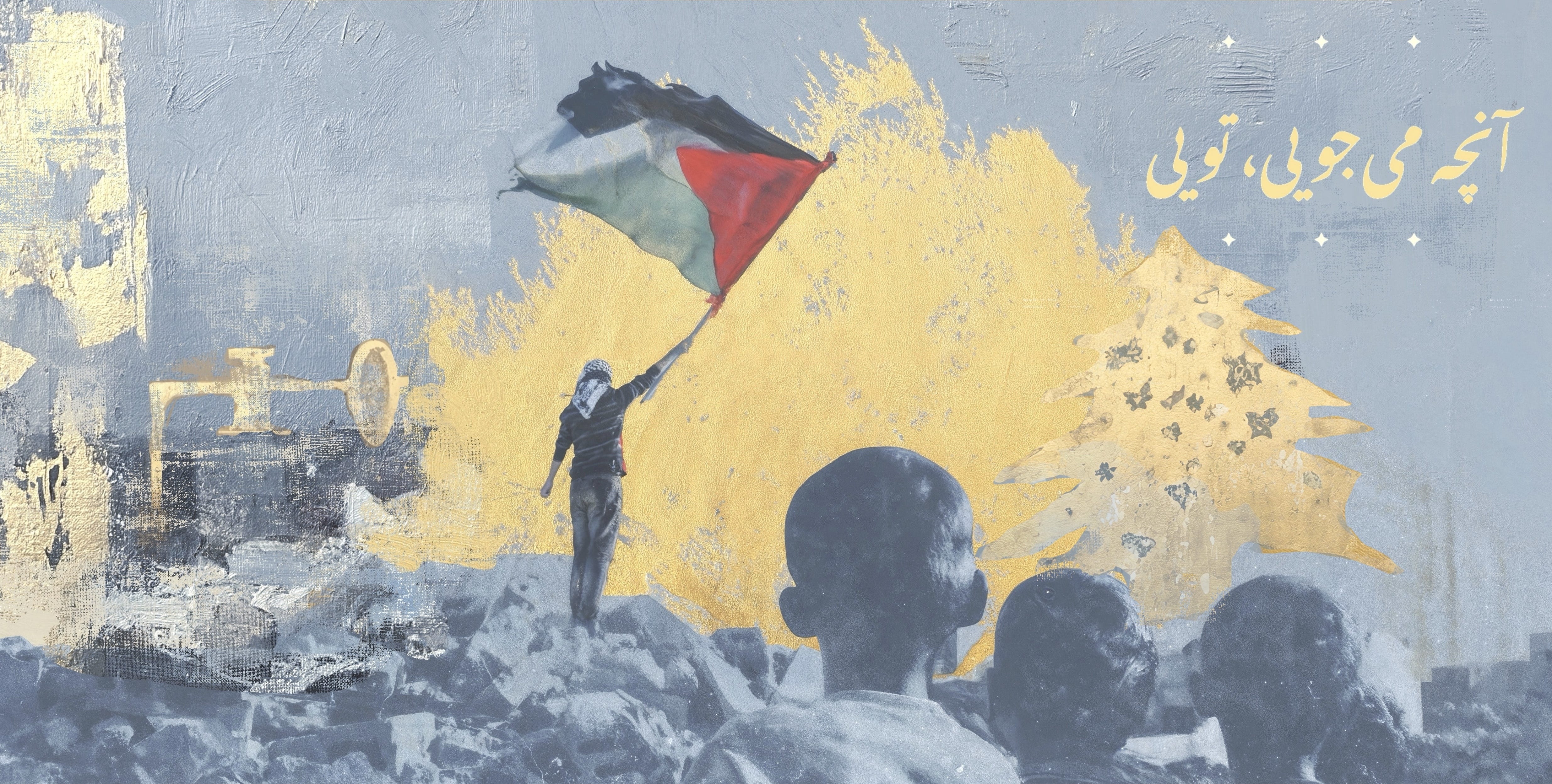
The history of Palestine and Lebanon has witnessed many events. When I read the name Ariel Sharon, the first thing that came to my mind was the Sabra and Shatila massacre that took place in 1982… and how I used to see the bodies on television in some reports, memoirs, and even in clips of national songs when I was young.
Israel is a cancer in the world, and it should not have been in the Middle East.
Leave aside all agreements, signatures, and normalization.. nothing is useful anymore… Fight Israel and drive it out from here before it finishes us all.
“A war within us” is the perfect title.
Because that’s exactly where the hardest battles tend to happen.