

The Bugs Bunny Gambit — by Norman Harman (@NorrieHarman)
On December 7, 2025, while touring the ruins of the Gaza cities Beit Hanoun and Jabalia, the Israeli occupation army’s chief of staff, Eyal Zamir, informed his troops that the “Yellow Line”—the demarcation beyond which Israeli forces have not withdrawn under the October ceasefire—is now “a new border line.” He acknowledged what every Palestinian already understood, what we have understood for decades: The temporary becomes permanent, the ceasefire line hardens into the frontier of annexation, and what is taken is never returned.
In the lexicon of Israeli territorial expansion, “security” has become what “the civilizing mission” was to the nineteenth-century colonial powers: an infinitely elastic concept that justifies whatever is done in its name, and whose fulfillment remains perpetually deferred. “Security” is never achieved, never declared sufficient, never allowed to reach a point at which the taking of land might finally cease. And this is because “security,” in the Israeli usage, is a perpetual emergency to be sustained—one that authorizes permanent expansion precisely because it cannot be pronounced complete.
Israel remains the only UN member state that has never declared its own borders. Its founding declaration deliberately omitted them, and no law has drawn them in the 77 years since—an omission that is itself a statement of intent. Israel has not defined the limits of what it has not finished taking. And now the taking continues by a mechanical logic, each move prepared by the last.
Colonial expansion in the postcolonial era—an era that declared such expansion impermissible in the 1960 Declaration on Decolonization, that enshrined self-determination in the UN Charter’s first article, that congratulates itself on transcending the crudities of the civilizing mission—demands alibis. You cannot simply conquer and announce that you are conquering; the international order no longer permits such candor, though it permits everything else. You must conquer while proclaiming peace. You must dispossess while offering “prosperity.” You must cage a population while speaking of “stabilization.” And so, the vocabulary of security provides not explanation but permission, not justification but alibi.
The method has a history, and the history has a name: the Nahal system. Kibbutzim like Nahal Oz in the Gaza envelope (territory in Israel within 7 km of the Gaza Strip), those attacked on October 7, now invoked to justify the Yellow Line, were themselves products of that doctrine, which converted ceasefire lines into permanent borders. Founded as military outposts along a provisional armistice line, they became civilian communities that required protection. Military outposts became civilian settlements; civilian settlements became facts requiring defense; defense required buffer zones; buffer zones will become settlements in turn.
This is what “facts on the ground” means—the Hebrew uvdot bashetach: Build first, justify later; possess first, legalize after. When justification is required, it is always supplied as “natural growth,” the phrase that emerged during the Oslo years to place settlement expansion beyond the reach of any building freeze. Families have children, children need homes, homes need land, land needs security, and security needs land.
The logic moves only in one direction, like a ratchet that cannot turn back. Israel takes, and if there is no response, the taking is normalized, absorbed into the status quo, treated as though it has always been so. The new boundary—no longer contested, no longer even visible as a boundary, simply the way things are—becomes the baseline for the next taking. If there is a response, it is extracted from its context, stripped of its history, presented as unprovoked aggression, as terror, as proof of what Israel has always said about the impossibility of peace. And this becomes the justification for an escalation that establishes an even more favorable position than before. Israel advances, whether there is resistance or acquiescence, whether the world condemns or applauds, whether the taking is called defense or war.
The ratchet has its narrative equivalent: a clock that is always started late. The question “Who started it?” is answered by beginning the clock at the Palestinian action, never at the siege preceding it, never at the occupation preceding the resistance, never at the dispossession that started everything, yet is treated as having started nothing. History is punctuated so that Israeli violence registers as response and Palestinian violence as aggression—a framing so embedded in Western media grammar that it has become reflex.
The framing has never been clearer, and once Palestinians are established as aggressors, they can be treated as such—bombed, starved, displaced, with no limit imposed by law or conscience. And when even this fails to produce what it was designed to achieve—submission, the final collapse of resistance—the method shifts, and the ceasefire in Gaza marks that shift. Resolution 2803, Trump’s “Comprehensive Plan to End the Gaza Conflict,” enacts the turn that colonialism always makes when force cannot complete the work: from overt assault to administered rule, from genocide to domestication.
A purported aggressor population requires oversight, administration, and, ultimately, re-education: hence, a “Board of Peace” to oversee a people never consulted on the board’s composition or mandate. Part of that re-education would involve what Netanyahu describes as “deradicalizing” Gaza, making an explicit comparison to Germany following World War II. The target is Palestinian society itself: its memory, its political consciousness, its capacity to name what has been done to it.
The comparison presents Palestinians as a defeated aggressor population, collectively culpable, requiring long-term external control, as if resistance to colonization were madness, and subjugation the cure. The United States ran the same cure on Native American children, in boarding schools founded on the formula “kill the Indian in him, and save the man”—re-education aimed at what a people remembered rather than at what it had done.
But Gaza is only one front in an architecture of expansion that spans the region. In Gaza, domination is administered directly—through continued killings, aid obstruction, stalled reconstruction, coerced displacement, and the slow work of “deradicalization”—until subjugation or, even better, depopulation. Across the Arab world, where colonization is physically impossible, the strategy differs. Domination is instead delegated to compliant regimes.
In the West Bank, the Palestinian Authority has for three decades provided the proof of concept—autonomy without sovereignty, security coordination without political agency, an elite collaborator class administering the occupation on behalf of the occupier. That arrangement has now been discarded in Palestine. Resolution 2803 hands Gaza to the Board of Peace and a committee of vetted technocrats; the PA is promised a role only after it completes a “reform program” whose sufficiency Israel will judge—a deferral designed never to end.
But the model will be exported. Arab states—and what Israel’s “buffer zones” have left of Lebanon and Syria—are being recruited to the same role, as subordinates rather than equals. They are expected to contain their own populations in exchange for regime survival, and to abandon Palestine as a political cause—and with it, the right of return for those of us still waiting.
Ten days after Eyal Zamir declared his new border, on December 17, Israel approved its largest export deal in history—$35 billion in gas to Egypt, a deal its minister of energy had announced as entrenching Israel as “a leading regional energy power on which our neighbors depend—and which they need,” and one that, given Egypt’s economic weakness, would in his words “make them think twice about taking any steps.” Gas and water technologies are also being dangled before Syria and Lebanon, on the minister’s stated condition: “the day Iran’s grip on the region is broken,” and Hizb-Allah ceases, in his words, to pose “a terrorist threat.”
The expansion continues. Through military fait accompli, resource dependency, U.S. pressure at the UN, and “peace plans” that function as ultimatums, what cannot be secured by military force is secured politically. Palestinians are expected to recognize Israel, renounce resistance, and accept the legitimacy of a state built on our dispossession, while Israel acknowledges nothing, cedes nothing, and reckons with nothing.
Normalization is the political name for this arrangement—the point at which injustice stops needing justification and begins calling itself peace. “Deradicalization” is its internalization—the colonial relationship no longer imposed from without but reproduced within, a region reduced through re-education to servility and amnesia.
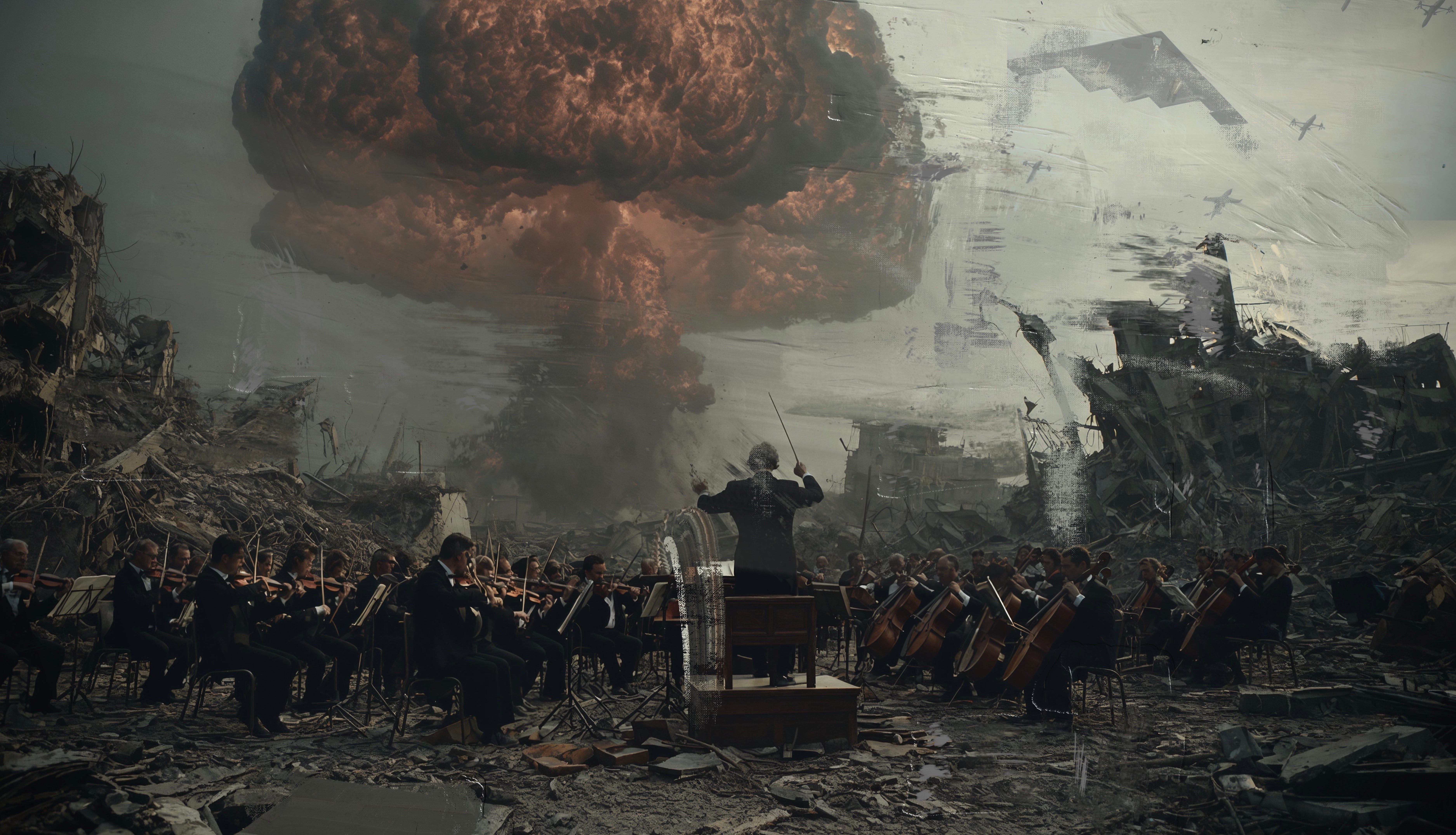
When occupation is “normalized,” peace is no longer a possibility but becomes a tool of oppression. This text is outstanding.
“… as though resistance to colonization were madness, and subjugation the cure…”
Thank you for writing in real time about what’s actually happening on the ground with a clear unambiguous understanding of what happens in Gaza will be exported.