

Gaza Painting in an Exhibition — by Norman Harman (@NorrieHarman)
I visited an exhibition of the Palestinian poet Mahmoud Darwish recently—personal artifacts, handwritten letters, a rich archive of his life and work. Among the artifacts was a letter he wrote from his first arrest to his brother Ahmed. He had been held since Thursday, he wrote, and did not know how long it would last. He described the cold, the sleeplessness, the interrogations, the clothes that were too small—but said the worst of all was being forbidden to write. This was the first moment he had been permitted pen and paper.
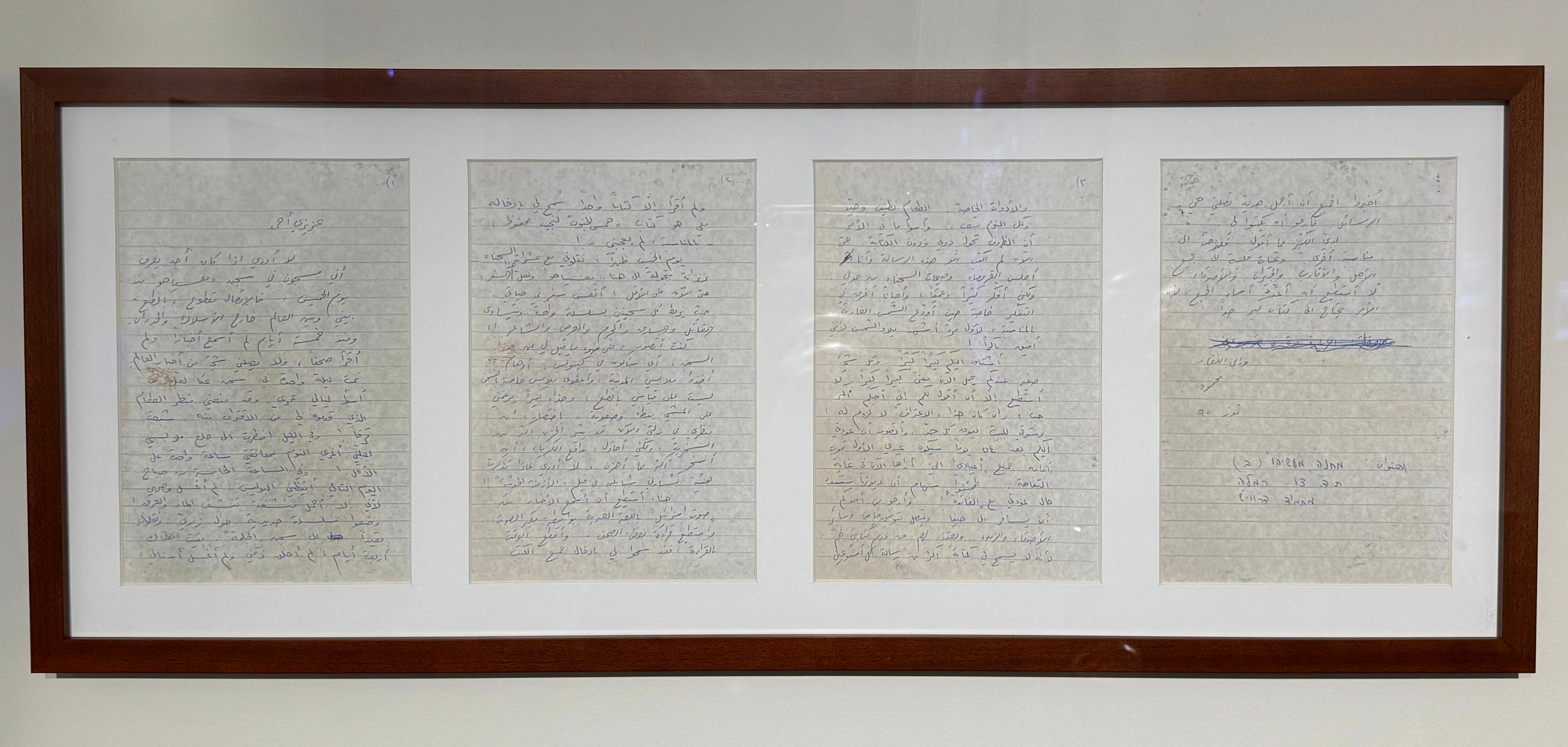
This exhibit is an archive of a voice that survived, that made it through. Such archives are rare—not because Palestinians lack poets or history, but because the machinery of erasure works on memory itself. Palestinian narrative has been buried from two directions: a Western apparatus that frames Palestinians as a threat rather than a people, and an internalized colonial perspective that made Arabs strangers to their own tradition.
Arabic culture and literature form a centuries-deep tradition—one that produced not only Darwish but the language and sensibility he drew from. The colonial project made us strangers to it. In elite schools across the Arab world, we were educated in French or English, taught more about the Second World War than about our own history, trained to see ourselves as grateful subordinates to a culture we could admire but never fully join. The purpose was not domination but alienation. We were severed from our own language, history, and memory. We were made strangers to ourselves.
If colonial education alienated us from ourselves, the discourse Edward Said called Orientalism taught Western audiences to see us as a threat. “Islam” was constructed as the civilizational opposite of the West—not through encounter with Muslim societies as they actually existed, but through projection and fantasy. The characterization intensified after the Cold War, when Western strategists needed a new enemy. Islam became monolithic: fanatical, irrational, medieval, incapable of separating religion and state, hostile to modernity. As Bernard Lewis put it in 1990, the Islamic world represented “the perhaps irrational but surely historic reactions of an ancient rival against our Judeo-Christian heritage.” Two billion people across dozens of countries, speaking different languages and shaped by distinct histories—collapsed into a single threatening essence.
This imagined Islamic other was then mapped onto Arabs specifically. The Arab became the face of Islamic threat, even though most Muslims are not Arab and the Arab world itself is vast and varied. In Western political culture, the Arab was recast as the fanatic, the terrorist, the suicide bomber—stereotypes that hardened into foreign-policy doctrine after 9/11.
Within this framework, the Palestinian question was stripped of its political and territorial nature. We were no longer resisting because we had been dispossessed of our land, expelled from our homes, subjected to military occupation. We resisted, it was said, because we were Arabs, and because our “civilization” was incompatible with the modern, democratic, Western values that Israel claimed to embody.
The brilliance of this framing, from a Zionist perspective, is that it transforms a colonial conflict into a civilizational one. There is no need to address 1948, the Nakba, the refugees, the settlements, the occupation, the checkpoints, the house demolitions—the concrete history of our dispossession. Instead, one is offered “the only democracy in the Middle East” surrounded by barbarism. Israel becomes the frontier outpost of Western civilization, and we become undifferentiated members of a hostile civilizational mass.
The “civilization vs. barbarism” binary works on multiple levels at once. It recasts resistance as irrational violence rather than political action. It renders Palestinian deaths less grievable because they are the deaths of those marked as “barbarians.” It conditions Western audiences to identify with Israel automatically, since Israel is imagined as “like us” while Palestinians belong to “them.” And it forecloses the possibility of seeing Palestinians as they are: a people with a history, with claims, with rights under international law—not representatives of an alien civilization, but human beings subjected to dispossession.
That narrative, however, could not endure indefinitely. October 7 forced something open. The world was confronted with the irreducible presence of Palestinians themselves—speaking, grieving, resisting, insisting on being seen as a people with a history and a claim. In its own way, the Al-Aqsa Flood made that peoplehood visible, forcing a story long told about Palestinians to be told, slowly and painfully, by Palestinians themselves.
But Al-Aqsa Flood also exposed something else: who would stand with Palestinians, and who would not. Gaza absorbed the full weight of Israeli military power with no external actor willing to intervene meaningfully. Arab regimes capitulated, choosing Washington over Gaza. International institutions performed concern without consequence. And the ceasefire frameworks that followed formalized this abandonment, offering Israel the cover of a “process” while Palestinians were left isolated inside it.
This pattern is not new.
“How large the revolution, how narrow the journey, how grand the idea, how small the state.”
Mahmoud Darwish wrote this in his poem In Praise of the High Shadow, composed after Sabra and Shatila—the 1982 massacre in which Lebanese Phalangist militia, under Israeli supervision, entered two Palestinian refugee camps in Beirut and slaughtered thousands of civilians over three days. Yasser Arafat and the PLO had evacuated to Tunis under American guarantees, but the international monitors meant to protect civilians were withdrawn; the refugees were left encircled by Israeli forces who let the militia in and lit flares through the night to help them see. Arab regimes looked on.
In the poem, Darwish addressed the PLO fighters directly. He questioned the trappings of statehood, suggesting the cause was always larger than anything a state could contain. The revolution was vast, the idea grand. The state proved small.
More than forty years later, that pattern has returned: a process offered as peace, abandonment formalized beneath it.
Today, Resolution 2803—urged forward by the Palestinian Authority and the same Arab states—shrinks liberation into a file administered by foreign powers. And in Rafah, the narrow journey returned in its most literal form: resistance fighters trapped behind the ceasefire line, hunted and killed one by one while the world insisted a ceasefire existed. Starved, encircled, abandoned.
In Praise of the High Shadow was among the artifacts in that exhibition. Standing before it raised questions: What language would Darwish have found for this genocide—for the children starving, the hospitals bombed with impunity, the families erased from the civil registry? But one pressed harder than the others: What would he have written about the fighters besieged in Rafah?
Many contemporary Palestinian writers have found language for it—language of precision and moral clarity. One line stayed with me: “We pride ourselves on the fact that they did not surrender and fought until their last breath… but we forget that all of us surrendered to our own helplessness, and were content to just watch.”
The tradition that produced Darwish has not vanished. In his cell, he was eventually permitted pen and paper. In Gaza, the machinery works to ensure no one will be permitted at all—journalists killed, poets buried under rubble, archives destroyed. But narrative is not so easily killed. Palestinians have been written out of history before—by the British, by the Zionists, by Arab regimes, by a Western consensus that declared we did not exist. Each time, the story returned. It returned because it was true, and because those who lived it refused to stop telling it.
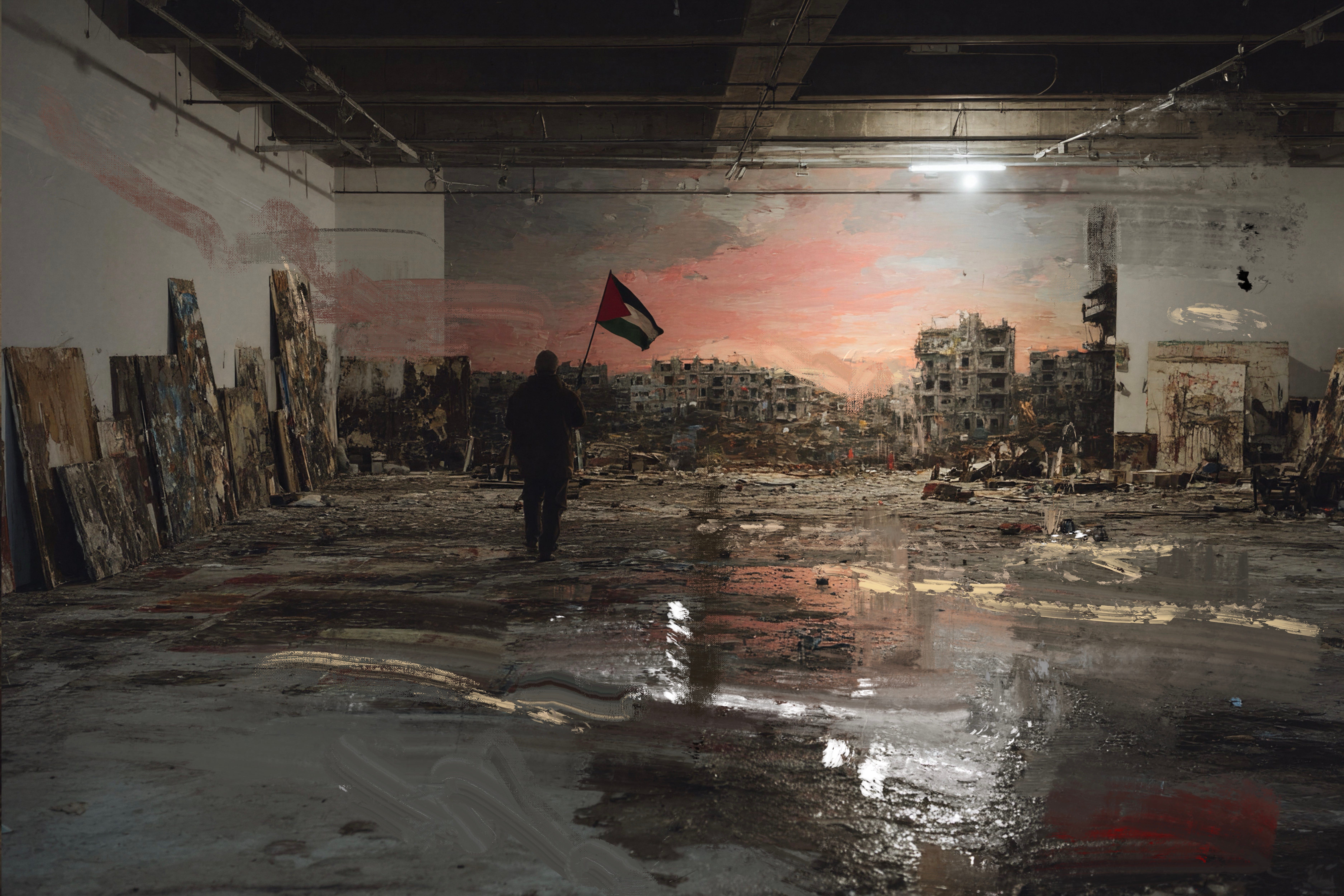
Reading this text brings to life the feeling of confronting an old yet living wound; a wound that is not just about a place or a historical moment, but about the human experience of being erased, ignored, and trying to maintain a voice. Beyond all the arguments and frameworks, what stands out in this narrative is the effort to keep humanity alive in the midst of difficult circumstances, an effort that flows through Mahmoud Darwish’s letters, in the archives, and in the memory that insists on not being lost. This text is a reminder that when memory is under pressure, writing becomes a form of survival; a way to preserve dignity, identity, and meaning. It is difficult to come across descriptions like the deprivation of writing, the cold of detention, or the sleeplessness and not feel how fragile “being” can become, and how much one struggles to preserve the smallest signs of self-being. Alongside the analytical and historical layers that the text alludes to, what strikes one most is the human voice, a human being who does not want to become a label, a stereotype, or an “other,” a human being who wants to be heard not as a reflection of a grand narrative, but as a person with experience, with pain, with memory. Ultimately, this writing is more than anything a reminder that behind every grand narrative, behind every conflict, and every complex history, there are human beings who are trying to hold on to what is left of them: their language, their story, their memory. And to see this human dimension is itself a form of respect.
It appears they’re “speed running” the North American settler-colonialism framework.
This history is fantastic! The details, “… Within this framework, the Palestinian question was stripped of its political and territorial nature…”
Your meta-analysis expands, illuminates, and destroys the dominant narrative.
This is the language, and conversation anyone who claims solidarity with the Palestinian people, Palestine with Jerusalem as her capital, and the resistance, must prioritize as the dominant narrative for the true history of the Palestinian people.
Thank you so much for this rigorous, and accessible entry to a world, and a history we’ve been denied.