

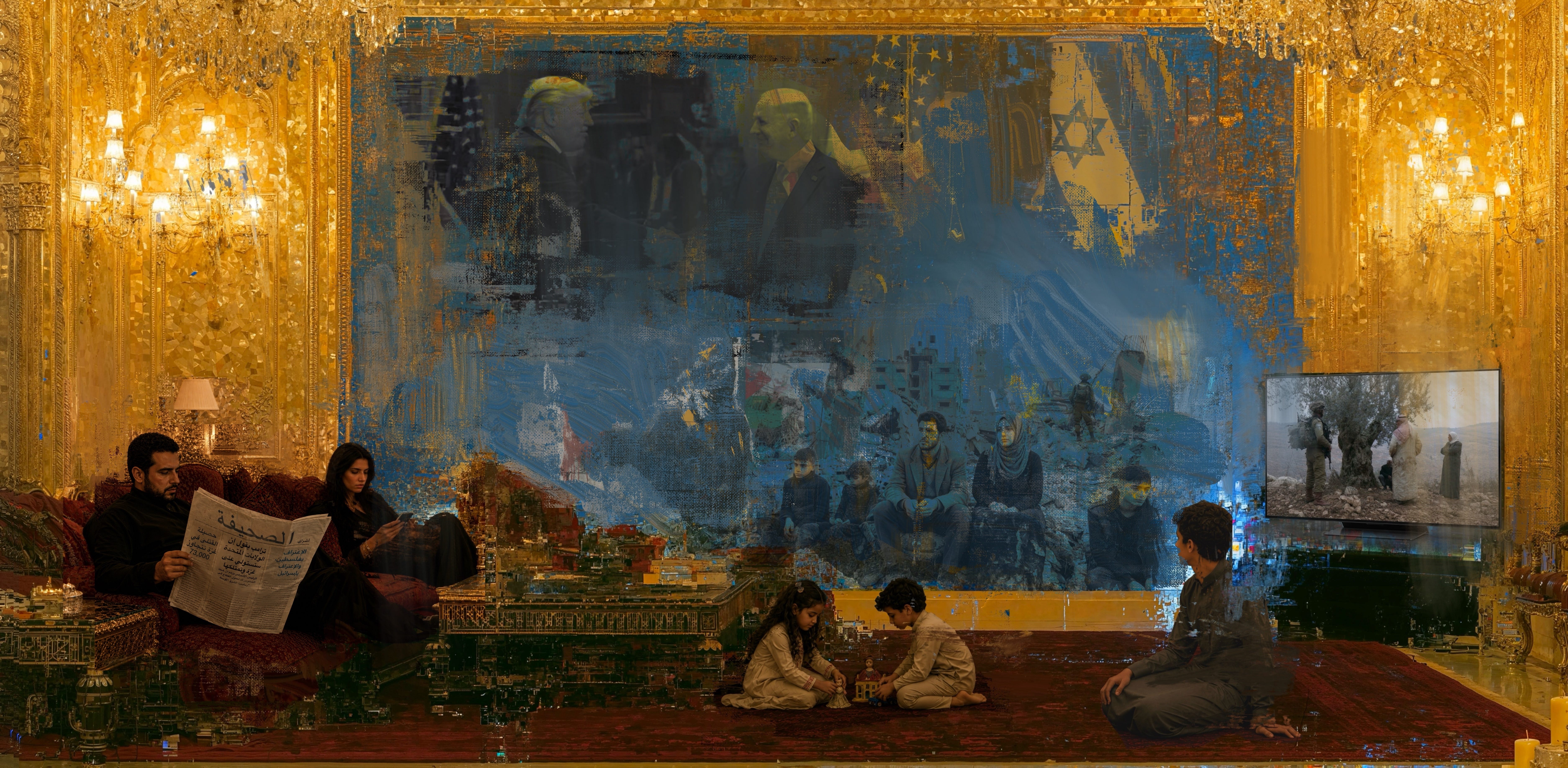
Living Room Extravaganza — by Norman Harman
Arab regimes moving toward normalization in the aftermath of the Abraham Accords—the agreements brokered by the United States in 2020 to normalize relations between several Arab states and Israel—faced a problem: their populations did not regard it as legitimate. The Arab liberal press set about supplying the legitimacy normalization lacked. That press, the Gulf-financed, secular-oriented media that styles itself the voice of Arab moderation, had its method: Acknowledge Palestinian suffering, concede the dispossession, and strip that acknowledgment of every political obligation it ever carried.
Three months after the Accords were signed, the Lebanese columnist Hazem Saghieh wrote in Asharq Al-Awsat (The Middle East) that “the Palestinian cause no longer intersects with the national concerns of the rest of the Arab states.”1 He did not deny Palestinian suffering or contest the justice of the cause. “Palestinian bitterness is perfectly understandable,” he wrote, “especially as settlement expansion, land confiscation, and the shrinking of the two-state solution continue to stifle an undeniable right.” He acknowledged Palestinian rights, then absolved Arab states of any obligation to act on them.
A few months earlier, when the Emirates announced its normalization, the paper’s former editor-in-chief, the Saudi columnist Abdulrahman Al-Rashed, had done the same. Al-Rashed had previously run Asharq Al-Awsat and then Al-Arabiya, the Gulf’s dominant 24-hour news channel, making him the most powerful journalist in Gulf-financed Arab media for nearly two decades—the Arab world’s Thomas Friedman. He began with the concession: “The losers, all these years, have been the Palestinians. Normalization takes place in their name, and they reap nothing from it—no return of lands, no recognition of the state.”2 Having made it, he pivoted: “Every Arab country has the same right to manage its international relations, including its relationship with Israel. This is a sovereignty matter that each country decides based on its interests, not based on what the Palestinians or other Arabs want.”
Neither column disputed the Palestinian cause. Both columnists acknowledged the suffering and the dispossession and, in the same breath, removed that cause from Arab politics. The grievance remained legitimate. The political claim it had once carried, they withdrew. The cause was acknowledged as just because it had been decoupled from any obligation to act on it.
Withdrawing the political claim serves two parties. The first is Israel, whose regional project depends on invulnerability to any future threat—a doctrine of permanent security that demands the annihilation of any recurring one. In Gaza and across Palestine, that includes civilians, children, and future generations. The doctrine defines the enemy as a permanent existential danger, so its removal can always be reframed as self-defense. Normalization is how Israel secures that invulnerability, converting states that were, at least notionally, frontline adversaries into partners or passive bystanders. Egypt in 1979, Jordan in 1994, the Abraham Accords states in 2020, and the Saudi track that has run intermittently since—each subtraction removes a source of leverage and tightens the encirclement of the one party left without a state, the Palestinians.
The second party served is the Arab regimes: Normalization is how they secure arms and diplomatic cover, and the technology to contain their own dissidents, including surveillance systems, crowd-control arsenals, and intelligence infrastructure. Israel buys regional invulnerability; the Arab regimes buy survival. The Palestinians are the residue that both parties write off.
For this arrangement to hold, political normalization requires ideological normalization. The Arab liberal press supplies it. Its arguments have been stable: Palestinian intransigence, rather than Israeli colonization, is the obstacle; realism means accepting Israeli hegemony; the Palestinian cause has cost the Arabs more than it was worth. Resistance becomes the crime; accommodation, the cure.
The Arab liberal press spans newspapers, television, and social media. It includes the pan-Arab dailies Asharq Al-Awsat and Al-Hayat; the television news channels Al-Arabiya and MBC; and a social media system that coordinates and amplifies the same arguments. All are Gulf-financed and broadly advance the same editorial line. Saghieh wrote for Al-Hayat before Asharq Al-Awsat, while Al-Rashed ran Al-Arabiya before Asharq Al-Awsat. These are the leading outlets of a formation that extends well beyond them.
That formation’s flagship is Asharq Al-Awsat—the paper both columnists now write for. It was launched in London in 1978 under Saudi patronage, around the time Egypt signed the Camp David peace treaty with Israel, the first peace agreement between Israel and an Arab state, thereby removing the Arab world’s largest military power from the Arab military front against Israel. In exchange, Egypt received American military and economic aid. The arrangement set the template: Arab states would normalize with Israel and receive American patronage, while the Palestinian cause would be managed separately, then deferred, then abandoned. The paper became the flagship pan-Arab venue for the political language of that order—the equivalent of the Financial Times or Le Monde in the Arab world.
It targeted the Western-oriented educated professional class across the Arab world and its diaspora—those whose financial interests are served by the regional order sustained by normalization, and whose alignment with it determines whether it becomes broadly acceptable. Their power is social and economic rather than political: they shape what is considered reasonable, legitimate, and safe for business. Their opinions, once shaped, travel downward into the institutions and conversations that govern public life.
The Arab public still stood with Palestine; the regimes no longer did. They were bound to Israel and, through Israel, to the abandonment of Palestine. The Arab liberal press’s task was to make that abandonment acceptable—to persuade the public to trade Palestinian claims of return and sovereignty, along with resistance to a future defined on Israeli terms, for promises of prosperity, modernization, and normal life.
The paper manufactured consent, amongst the class it cultivated, to the political direction of the Arab regimes sustained by American protection, whose survival now depended on alignment with Israel. It designated which Arab claims could survive in the public imagination and which could not. The Palestinian cause was not to survive: by the time of the Abraham Accords, normalization had become the regional default.
The Abraham Accords were the first Arab-Israeli agreement to bypass Palestinian statehood, but once Israel’s genocide in Gaza began, the Arab public could not be sold Israeli integration. Eleven weeks into the genocide, with the international community again calling for a Palestinian state, Al-Rashed published “This Is the Way to Get Rid of Hamas.”3 He called on the international community to establish a Palestinian state, “so that there will be no movement like Hamas, and so that there will be no existential danger to the Israelis.” Palestinian statehood, in this account, existed to protect the occupier. Its sovereignty would extend only as far as Israeli security permitted—a state to contain Palestinian politics rather than express it.
“The international community then has the right to dictate to the Palestinians about preventing Hamas, the Brotherhood, and the extremists,” Al-Rashed wrote. In 2020, he had reserved the sovereign right of Arab states to decide—“based on their interests.” In 2023, he transferred that sovereign right to the international community and turned it against the Palestinians: the right to establish the Palestinian state, and the authority to dictate the terms of its sovereignty. Sovereignty, in this discourse, is positional: an attribute of everyone in the region except its victims.
Facing enraged populations and their own exposed complicity, the Arab regimes proposed a Palestinian state at the Security Council—stripped, in advance, of everything that would make it one: no control over borders or airspace, no military, no sovereignty, no right of return. The United States vetoed it and produced the Trump plan instead—a plan Trump declared would have the U.S. “take over the Gaza Strip” and “own it.” UN Resolution 2803 endorsed that plan in November 2025, and the Arab regimes welcomed it.
What the regimes welcomed, the press, once again, made thinkable. “‘New Gaza’ and ‘Green Rafah’ are the two catchwords of a rubric coming at us with promises of a prosperous future for Gaza,” Saghieh wrote of the Trump Board of Peace’s reconstruction scheme.4 “The French Riviera was proposed as the model to emulate.” He described a “paradise on earth” that was being built in the 58 percent of the Strip behind Israel’s yellow line, and “hell” in the rest. He cited former Israeli prime minister Ehud Olmert calling one reconstruction project “a concentration camp for Palestinians.” “As for the displacement of Gaza’s population, the genocidal war and its repercussions, and the political future of the Palestinians, that is all swept under the rug,” Saghieh added. “But it doesn’t silence the innocent question: What is objectionable about making Gaza resemble Dubai or the Riviera?”
To ask the question, Saghieh had first to concede the horror—the displacement, the genocide, the concentration camp named as such by an Israeli prime minister—and then set it aside. The Israeli public needed no such innocence about its eliminationist intent. Eighty-two percent support the ethnic cleansing of Gaza’s entire population; 47 percent support killing all civilians in cities the army occupies. What the Israeli public states as intent, the Arab liberal press poses as a question.
The innocent question was a pretext. Saghieh’s critical posture was theater—no different from the Arab regimes’ statehood proposal. Both ended in capitulation to the terms of the Trump plan. For years, the Arab liberal press had sold the Arab public a position it called realism—that the power balance favored Israel and the United States, which sustains it, and that the only realistic response was capitulation.
With the killing of Yahya Sinwar and Hassan Nasrallah, the leaders of Hamas and Hizb-Allah, the realism argument found its moment. Israel, Al-Rashed wrote, was in “a stronger position than before,” no longer pressured to negotiate with the resistance.5 In an October 2024 column titled “Israel Does Not Intend to Stop,” he argued that “the Lebanese army should carry out its duty of protecting the borders, and end Hizb-Allah’s military role.” Without this, Israel would “continue its military operations until the coming spring, until the elimination of the last armed fugitive in Lebanon, and the country will have been destroyed because of it, and Hizb-Allah will be finished militarily and politically.” The threat was Israeli; the duty, the guilt, and the ruin were all Lebanese.
To Al-Rashed, Hizb-Allah’s coming elimination would vindicate the argument: Resistance had sealed its own fate by refusing to capitulate, and what remained for Lebanon was to accept the terms. Resistance was futile, and worse than futile—it was what licensed the destruction. On the second anniversary of October 7, he returned to where the argument began. Al-Aqsa Flood, he claimed, had given Israel a license to destroy a list of regional targets it had already prepared.6 Hamas’s attacks were like Gamal Abdel Nasser’s closure of the Straits of Tiran in 1967, an opening Israel had been waiting for to settle its confrontations with Egypt, Syria, and Jordan. “Tens of thousands of Gaza residents,” he wrote, “perished because of Hamas.”
Israel has killed over 73,000 Palestinians. Its own military intelligence database recorded 83 percent of those killed as civilians. More than 1,000 of them were babies under the age of one. Hamas did not do this. The UN Commission of Inquiry confirmed in June 2026 that the deliberate targeting of children is among the key elements establishing Israel’s genocidal intent.
In the days that followed, Saghieh widened the circle of the accused: The resistance shared the blame for Israel’s genocide, and so did the Arab public. The “Levant’s mainstream political culture,” he wrote, was afflicted by “inveterate inertia.”7 It had shown itself unwilling to recognize realities, accept Israeli-American regional power, or carry out the “radical reviews” that would have abandoned resistance. The culture was “incapable of practicing self-change.” “This task,” he wrote, “was left to Israel,” and Israel “undertook to complete it with genocidal spite.”
The genocide was, in his framing, the consequence of Arab refusal to internalize the colonial hierarchy. With nothing to stop it, and with diplomatic impunity, Israel consolidated a regional order around itself—what Saghieh called an “imperial strategic sphere” that “provides Israel with security” and “obliges everyone to deal with this situation as a fait accompli.” Inside it, the colonized were to recognize the colonizer’s victory, abandon their political claims, and live as subjects of an order they had no standing to contest.
That fait accompli holds through a perpetual exchange of enemies. Permanent security requires a permanent threat, and once one has been neutralized, another must be designated. As normalization advanced, the Arab states adopted Israel’s enemies as their own, shifting the standing antagonist from Israel—once the object of pan-Arab enmity—to Iran and to “extremism.” “As for the ‘cause’ that remains,” Saghieh wrote, “it is the ‘cause’ of the Iranian regime.”8
The substitution was collaborative. A year earlier, Al-Rashed had already installed Israel as the region’s strategic savior. “Netanyahu may seem reckless, firing in all directions,” he had written around the first anniversary of Al-Aqsa Flood, “but in reality, he is following a well-structured plan with a clear objective. Few expected him to be capable of this—dismantling the major regional Iranian threats surrounding Israel.”5
In May 2026, in the wake of the Israel–U.S. war on Iran, Al-Rashed wrote that the region was witnessing “a conflict between two projects, ‘Greater Israel’ and ‘Greater Iran.’”9 Iran, he claimed, had built “a regional empire stretching from the Caspian Sea to the Mediterranean” through four decades of “expansionist wars.” The empire had grown too dangerous to leave standing. Greater Iran had compelled Israel and the international community to “push back, and eventually, destroy the project before it could consolidate itself with nuclear weapons.”
Greater Israel, he dismissed outright. “If Israel truly intended to expand,” Al-Rashed wrote, “it would openly declare, promote, and justify such aims.” Conquest, on this standard, must announce itself before it can be named; a state that expands without declaring is acquitted of expansion. It was, he insisted, a project of “influence and regional dominance,” not territorial expansion. Al-Rashed ignored that Netanyahu had already said he was “very much” connected to the vision of Greater Israel and “absolutely” subscribed to it. He ignored, too, that Israel—the only country in the world without defined borders—has expanded by close to 7 percent since October 7, across Gaza, the West Bank, Lebanon, and Syria.10
Still, Al-Rashed absolved Israel of expansionism, dismissed “Talmudic Greater Israel” as “political fiction,” and fixed Greater Iran as the region’s real expansionist threat. Stripped of any expansionist appetite, the “regional dominance” he granted Israel was no longer a threat to resist. It was a settlement to accept.
What remained was stripping Israel’s project of any colonial name—of expansionism in Al-Rashed’s argument, of settler colonialism in Saghieh’s. “The settler-colonial label,” Saghieh had long argued, “isn’t a perfect fit” for Israel.11 “Yes, there were arrivals of foreigners, and expelling and displacing most of the local population in 1948, but that does not mean these actions were linked to a settler project.” He conceded the settlers and conceded the expulsion, but still rejected the settler-colonial nature of Israel. The word Nakba—the name Palestinians gave to the catastrophe of being driven from their ancestral homeland by these foreigners—he did not use. With a fifth of the population Palestinian Arab, he argued, calling Israel “alien to the region” began to “sound rather strange.”
Saghieh’s May 2026 column “What Future With Israel?” argued that describing Israel as a “settler-colonial entity” treats its colonial origin as its permanent and defining characteristic. In his view, this implies that Arab rejection of Israel is based not on its policies or conduct, but on its very existence, making the conflict one of immutable identity rather than political disagreement. The label had done, he wrote, “nothing but make the past govern the future and exclude politics,”12 leaving no path to political accommodation. Into that closed space, Al-Aqsa Flood arrived. “Accompanied by no small amount of celebration and glorification,” it convinced “a large Israeli majority that neighboring countries harbor nothing toward them but genocidal intent, prevented only by lack of capability.” Together, he argued, they drove Israelis to “this level of genocidal savagery” in Gaza. “Thus Israel was driven, after the October 7 operation, from self-defense into policies of savagery,” Saghieh concluded—“and we were not innocent in causing it.”
He criticized Israel’s genocide while explaining it into justification. He refused to name Israel as colonial. With practiced innocence, he made Palestinians and Arabs the cause of Israel’s genocide.
In this, the Arab liberal press has been consistent. Saghieh’s July 1, 2026, column, “The Framework Agreement and Self-Responsibility,” extended the argument to Lebanon and to critics of the Lebanese-Israeli framework agreement. Those critics—who described the Lebanese state as a “puppet authority” and any agreement with Israel as an “agreement of shame”—were, he sarcastically wrote, “our angels, who in all their history have committed nothing but innocence.”13 According to him, these “angels” bore collective responsibility for every catastrophe they claimed innocence of. Their rejection of the agreement, he warned, would only “deepen misery and decline, and give Israeli savagery more fangs of brutality and domination.”
The agreement barred Lebanon from pursuing Israel in any international legal forum; required the Lebanese army to disarm Hizb-Allah on a timeline Israel would verify; conditioned Israeli withdrawal on performance the Lebanese army must prove to Israel’s satisfaction; left Israel’s occupation of Lebanese territory in place indefinitely pending that proof; said nothing about Palestinian refugees—Lebanon’s oldest unresolved claim—and, as always, left Israel’s borders undefined. The collective responsibility Saghieh demanded was the responsibility to accept, without complaint, terms that left Lebanon without recourse.
Such are the terms. The Arab liberal press supplies Israel’s regional hegemony with the language of reasonableness, legitimacy, and managed inevitability. It has acknowledged every crime, named every victim, and conceded every dispossession—only to withdraw every political obligation that acknowledgment once carried. What began in December 2020 as the decoupling of Palestinian suffering from Arab political commitment continues, in July 2026, as the demand that Lebanon accept, without complaint, a settlement written entirely on Israeli terms. What the press calls realism is the acceptance of Israeli hegemony—the acknowledgment of every crime, the concession of every loss, and the delegitimization of every form of resistance that might have contested either.
1. Hazem Saghieh, “Normalization, the Cause, and Some Unspoken Matters,” Asharq Al-Awsat, December 12, 2020. https://aawsat.com/home/article/2679246/حازم-صاغية/التطبيع-والقضية-وبعض-المسائل-المسكوت-عنها
2. Abdulrahman Al-Rashed, “The UAE and Israel,” Asharq Al-Awsat, August 14, 2020. https://aawsat.com/home/article/2448601/عبد-الرحمن-الراشد/الإمارات-وإسرائيل
3. Abdulrahman Al-Rashed, “This Is the Way to Get Rid of Hamas,” Asharq Al-Awsat, December 28, 2023. https://aawsat.com/الرأي/4754726-هذه-هي-الطريقة-للتخلص-من-«حماس»
4. Hazem Saghieh, “Palestine: A Future Without a Past and a Past Without a Future,” Asharq Al-Awsat, November 30, 2025. https://aawsat.com/الرأي/5214285-فلسطين-مستقبل-بلا-ماضِن-وماضِن-بلا-مستقبل
5. Abdulrahman Al-Rashed, “Israel Does Not Intend to Stop,” Asharq Al-Awsat, October 19, 2024. https://aawsat.com/الرأي/5072537-إسرائيل-لا-تنوي-التوقف
6. Abdulrahman Al-Rashed, “October 7 Was Not the Reason,” Asharq Al-Awsat, October 7, 2025. https://aawsat.com/الرأي/5194454-السَّابِع-من-أكتوبر-لم-يكن-السَّبَب
7. Hazem Saghieh, “Questions of the Post-Gaza War Levant,” Asharq Al-Awsat, October 12, 2025. https://aawsat.com/الرأي/5196265-عناوين-مشرقيّة-لما-بعد-توقّف-القتال-في-غزّة
8. Hazem Saghieh, “On Gaza and Palestine and October 7,” Asharq Al-Awsat, October 8, 2025. https://aawsat.com/الرأي/5194867-عن-غزّة-وفلسطين-و٧-أكتوبر
9. Abdulrahman Al-Rashed, “‘Greater Israel’ and ‘Greater Iran’,” Asharq Al-Awsat, May 2, 2026. https://aawsat.com/الرأي/5268410-إسرائيل-الكبرى-وإيران-الكبرى
10. On West Bank land seizures since October 7, see: “Israel seized 12,800 acres of land in occupied West Bank since Oct. 7,” Anadolu Agency. Link And: “Israel approves major illegal settlement expansion in occupied West Bank’s Jordan Valley,” Anadolu Agency. Link
11. Hazem Saghieh, “On the Unity of Massacres in Our Region,” Asharq Al-Awsat, April 23, 2025. https://aawsat.com/الرأي/5135331-عن-وحدة-المجازر-في-منطقتنا
12. Hazem Saghieh, “What Future With Israel?” Asharq Al-Awsat, May 6, 2026. https://aawsat.com/الرأي/5270070-أيّ-مستقبل-مع-إسرائيل؟
13. Hazem Saghieh, “The Framework Agreement and Self-Responsibility,” Asharq Al-Awsat, July 1, 2026. https://aawsat.com/الرأي/5290626-اتّفاق-الإطار-والمسؤوليّة-الذّاتيّة
Thanks for this detailed explanation of the compliant subservience of the "liberal" Arab media, Abu Alya. Very informative. And the illustrations are excellent too.
“Press” is too generous a noun for those field slaves; at best, they are stenographers shackled by the Shekel, at worst, cowards, living on their knees, who gleefully condemn their offsprings to eternal enslavement.
Glorified gas attendants will never ever even smell what freedom means, let alone taste it; it falls upon their people to topple over those whom empire meticulously headhunted for being extra servile/pliable and installed as broken puppets with strings in the first place.
That circus will, sooner rather than later, fall like the cheap deck of cards it’s made of.