
Sunday Golf — by Norman Harman
Israel is a lie. Not just because it was founded on a lie, but because lying was required to make its existence appear natural, moral, and inevitable. Zionists built a world out of the lie, and then taught the world to believe it. They said they were coming to a land without a people. They said they were coming to a barren desert, a wasteland of rocks, thorns, and swamps and they made it bloom. But Palestine was neither empty nor barren. For thousands of years there had been farmers who knew and loved the land through olives, onions, strawberries, and oranges. It was a country with newspapers and magazines, cinemas and theaters, a developed civic and agricultural life. None of this could appear in Zionist propaganda, because the existence of a people would have exposed the fraud on which the entire story depended. So they had to write the people out of the story before they could take the land. That is why Israel is a lie.
The tragedy is that even we, Arabs, have begun to believe this lie. Arab rulers help sustain it, presenting normalization with a state built on Palestinian dispossession as a path to peace. The greater tragedy is that the world has accepted the original lie and continues to believe the lies Israel tells about itself—its innocence, its survival, and its restraint.
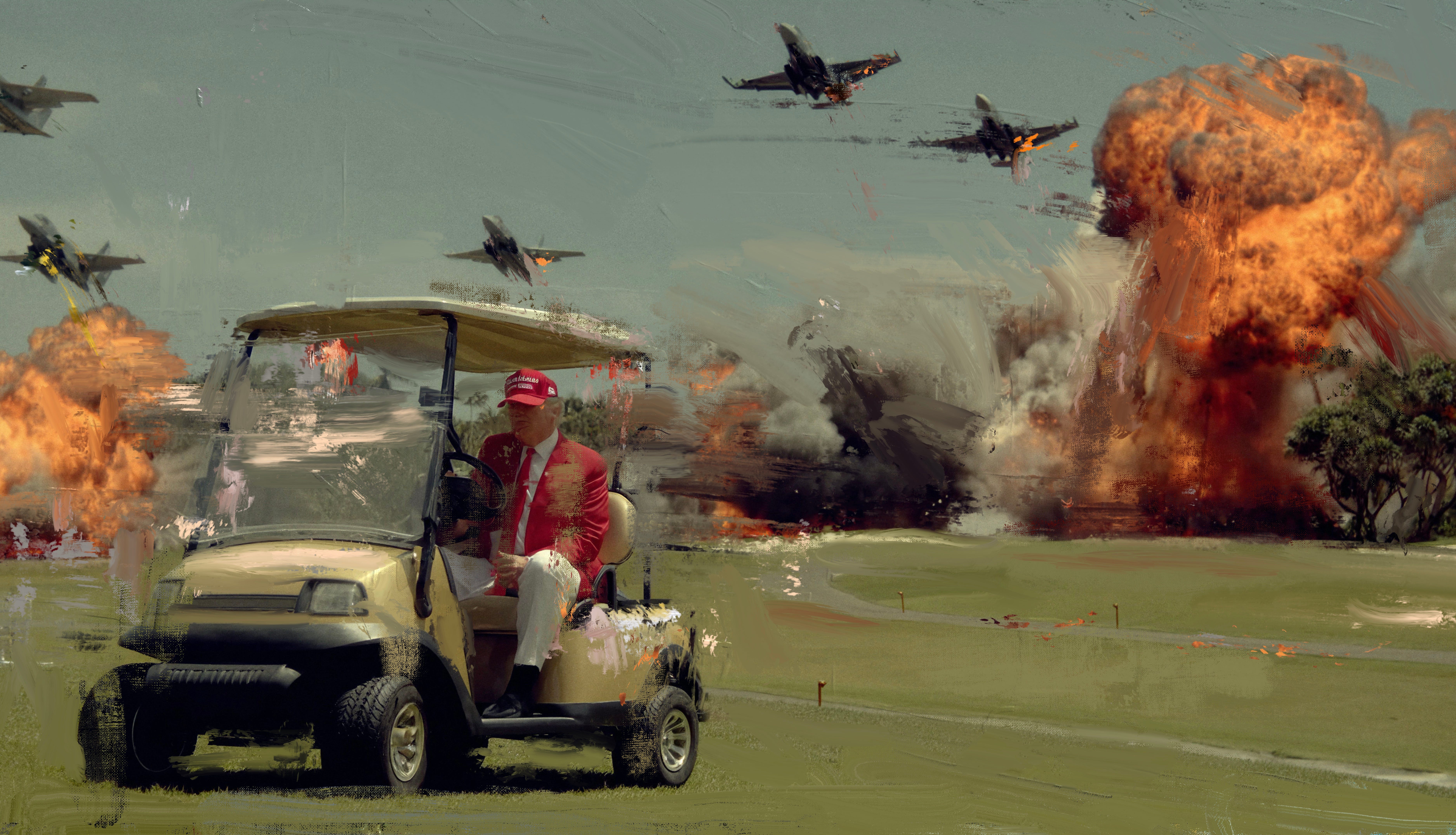
The world’s acceptance of these lies made possible a war against Iran, one built on pretexts nobody believed, with objectives shifting by the day, producing ruin nobody will account for. Netanyahu, at least, has been candid. This, he said from the first day, is what he has hoped to achieve for forty years: forty years of warnings about an Iranian bomb that never materialized, forty years of failed attempts to drag Washington into his war. It took an American president of singular arrogance, indifferent to the world he was driving into chaos, to finally give him what he wanted.
Trump exploited the Iranian people—their wounds, their aspirations, their rights—as the war’s justification. These are not invented grievances, but neither Trump nor Netanyahu will ever be their champion. Within days, Trump had dropped the demand for “regime change” and replaced it with the demand to choose Iran’s next “great and acceptable” leader, from the same government, himself. The Iranian people had gone from justification to afterthought—they had served their purpose, which was the license their suffering provided.
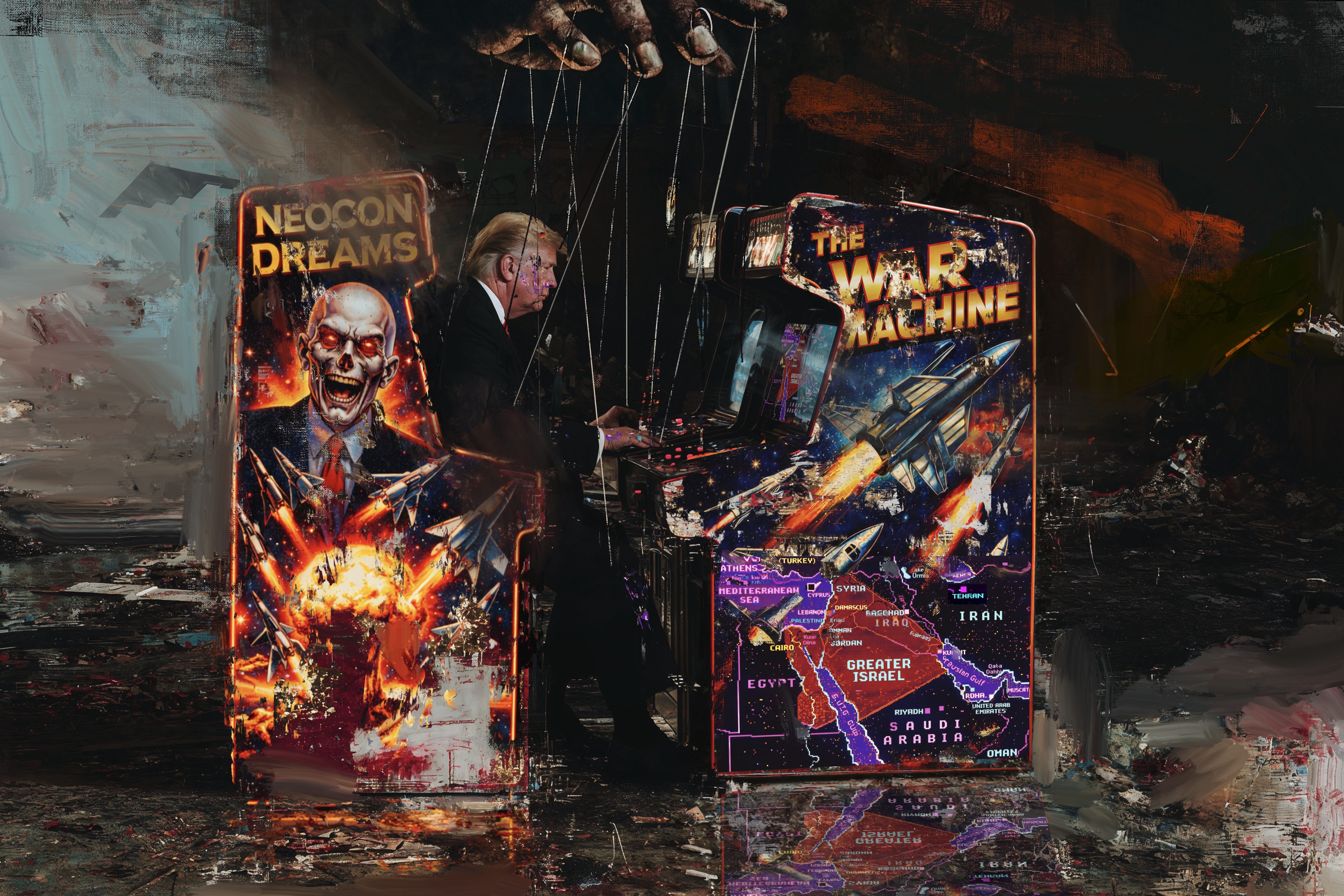
This war has been presented as a crusade for freedom against theocracy, between a people and their oppressors. What it enacts is the oldest binary: colonizer and colonized. And the colonial project advancing under that guise is Greater Israel—a biblical mandate, a regional plan, and a map that has been waiting for this moment.
Greater Israel is a territorial claim. It imagines a region stretching from the Nile to the Euphrates: running northeast through the Sinai, north up the Mediterranean coast through Palestine and Lebanon into Syria, and east to the Euphrates in southeastern Turkey, where the river rises. From there, it traces the river south through Syria and Iraq, with its southern arc taking in Jordan and the northern reaches of the Arabian Peninsula. This is the territory Netanyahu has called a “historic and spiritual mission” to claim.
When the right-wing political commentator Tucker Carlson asked Mike Huckabee, the United States Ambassador to Israel, whether Israel was entitled to the sovereign territories of Arab states across the region, Huckabee did not hesitate: “It would be fine if they took it all.” This Zionist vision claims a vast territory; the order behind it reaches further still. Every state within its shadow—Iran, the Gulf states, Turkey, Egypt, and the states of North Africa and the Horn, from Morocco to Somalia—faces two futures. The first is subservience: a regime autocratic and loyal enough to Israeli and U.S. power to contain whatever resistance its population might generate. The second is fragmentation: the breaking of a state into sectarian and ethnic cantons warring with each other, too consumed by internal conflict to organize any external resistance.
Israel and the United States hold up a state that accepts subservience as proof that the region can be peacefully integrated into their order. They hold up a fragmented state as proof that resistance leads to ruin. What the order cannot accommodate is a coherent, armed state that refuses both conditions. So, as long as the lie that is Israel exists, the wars will continue: wars to destabilize, wars to neutralize, wars to expand, each one pulling another state into subservience or leaving it in ruins.
The assault on Iran is the latest act in a single continuous war against every force in the region that resists the order Israel and the United States have imposed over decades. That order’s foundation is the permanent dispossession of Palestine—and from that conquered center, the violent reorganization of the entire region around Israeli dominance.
Palestine is the question on which every other question in this region depends. Every war has been fought to settle it, and every negotiation has been calculated to defer it. What is happening now is the latest attempt to liquidate it, and in that sense, Gaza and Iran are two theatres of the same war. The genocide in Gaza established the terms under which Iran is now being destroyed: A campaign of mass killing could be conducted in full view of the world, with the financial and military backing of the United States while the world watched. What the Security Council delivered, veto after veto, was time—time for the killing to continue, time for the facts to become irreversible. What the world allowed in Gaza, it is now allowing in Iran—and the killing it allows in Iran, it will allow again.
A kind of knowledge comes from being on the receiving end of this order. We learn that power, at a certain threshold, no longer requires convincing lies. Justification becomes perfunctory—a formality performed for a world that had already decided the killing was acceptable.
We have been here before. Not “we” as in the Western world, which calls itself civilized while deciding, again, that it may wage wars with impunity. We are those for whom the wars have never stopped.
Excellent post with so many pertinent points. Yes, Palestine is the crux. And yes, this whole entity, "Israel", I built on lies, lies, lies.
The mask has been removed. The world now sees Israel for what it is, and has always been — a genocidal, terrorist state causing nothing but chaos, pain and death in the entire region.