
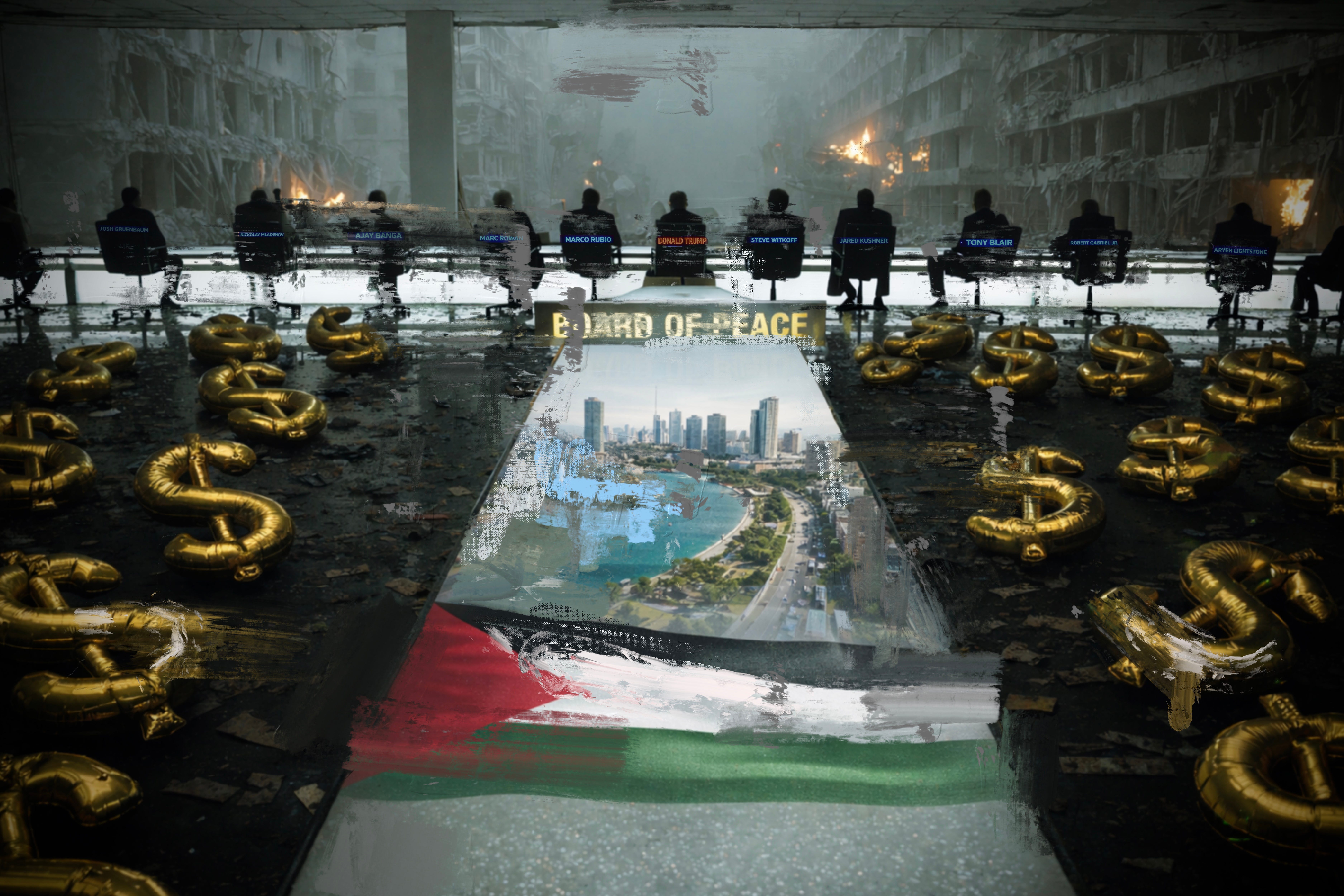
Board of Peace — by Norman Harman (@NorrieHarman)
In the years after the First World War, colonial rule could no longer be openly declared. The American president Woodrow Wilson had made self-determination a war aim; having proclaimed it, the victors could not openly seize the Ottoman provinces as spoils without discrediting the principle they had fought for. The mandate system, devised at Versailles, offered a solution: colonial control named as “trusteeship,” foreign rule extended without limit, sovereignty not denied but deferred. The administered population would be guided, prepared, and readied for self-governance. The preparation would continue as long as the administering power found it useful.
Following this model, Palestine was placed under British mandate in 1920. That mandate held the ground until Zionist settlement could advance; by 1948, Palestinian society had been destroyed.
The mandate has returned 106 years after it was imposed. President Donald Trump’s “Board of Peace” plan offers Gaza peace as foreign administration rather than sovereignty, management whose purpose is the slow and permanent subjugation of an entire population.
When Trump signed the Board of Peace into being, he touted it as “the Greatest and Most Prestigious Board ever assembled at any time, any place.” A leaked resolution vests all legislative and executive authority over Gaza in this board, including emergency powers and control over the administration of justice. Trump serves as chairman, holding sole final authority over its decisions. Netanyahu also sits on the Board, alongside its architects. Palestinians do not.
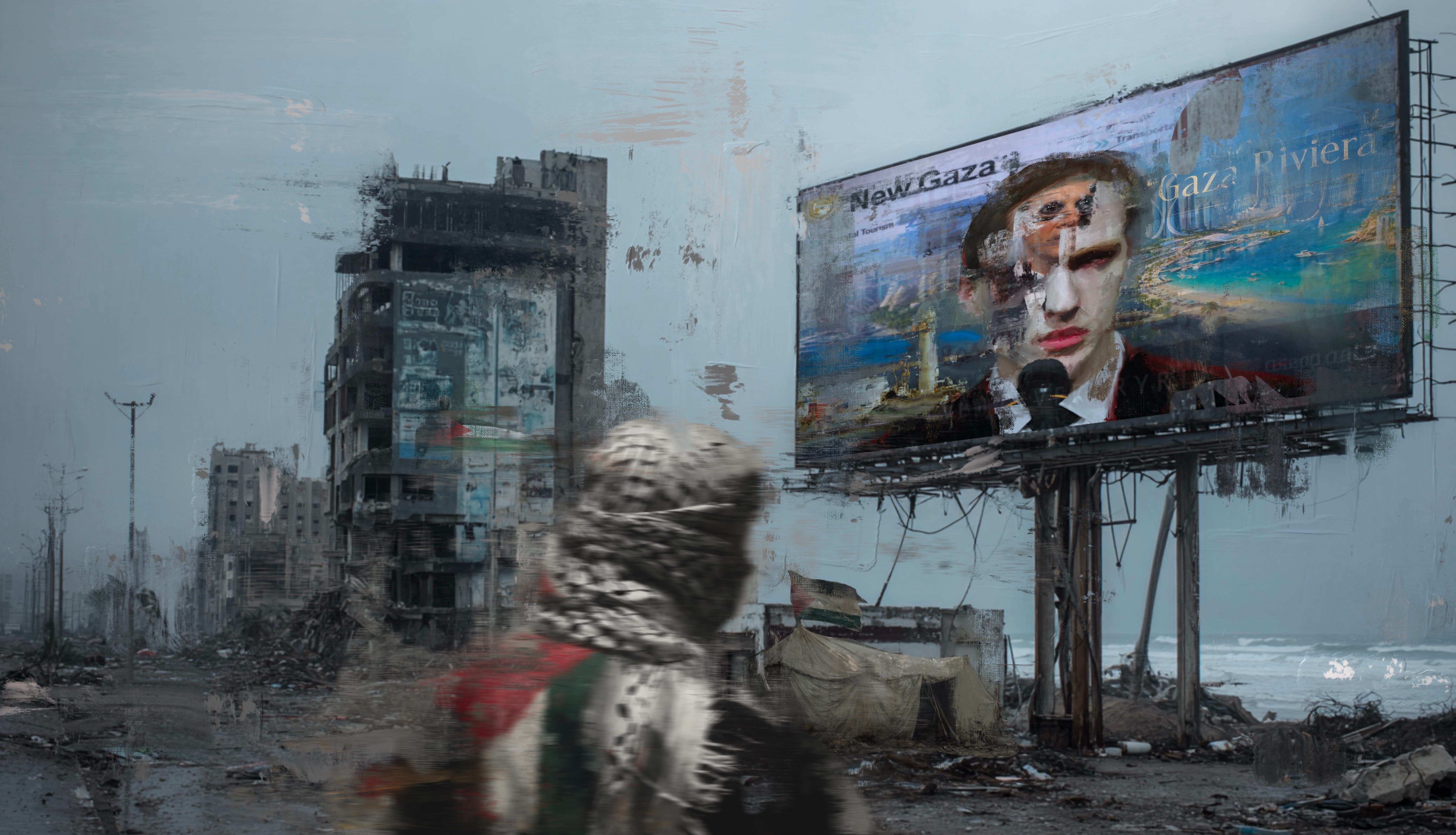
The Board’s purpose is not only “peace,” that is, the subjugation of Palestinians, but also to provide massive investment opportunities. At the World Economic Forum in Davos, Switzerland, in January 2026, Jared Kushner presented a “master plan” for Gaza: the shoreline where Palestinians now live rezoned for “coastal tourism,” the interior parceled into residential blocks, data centers, and “advanced manufacturing.” An Israeli-Cypriot real-estate billionaire seated on the board had pitched the coast as a “new Mediterranean Riviera with 200 hotels and potential islands.” The Palestinian population is to be penned in the wasteland and the reservation so the shoreline can be sold.
Below the Board sits a National Committee for the Administration of Gaza, described in the leaked resolution as a “vetted, technocratic, apolitical” Palestinian body. It operates under Nickolay Mladenov, formerly the UN’s Middle East envoy. Under the British mandate, Herbert Samuel arrived in 1920 as High Commissioner for Palestine; Mladenov arrives in 2026 as High Representative for Gaza. The titles repeat, as does the vocabulary: development, trusteeship, security, order. Samuel came to hold the ground until Zionist settlement could advance. Mladenov comes to administer a territory that the settler-colonial project has failed to empty.
The mandate has returned because military force failed. Israel’s war achieved none of its objectives: not the destruction of Hamas, not the “total victory” repeatedly promised by Netanyahu, not the ethnic cleansing Israel attempted in Gaza. The Palestinian people remain. Palestinian resistance remains. Where military force failed, administration takes over, made possible by Western liberal discourse, which provides the moral cover, and Arab collaboration, which furnishes the political legitimacy.
The moral cover requires two voices—one for the conquest, one for the conscience. The voice for the conscience speaks of peace; the voice of conquest knows that peace is the means by which conquest advances. It speaks plainly when it thinks no one is listening. During the Great Palestinian Revolt of 1936, an uprising against British rule and the Zionist colonization it enabled, David Ben-Gurion, Israel’s founding prime minister, was debating whether to accept a British partition plan. He named the logic without ornament: “Peace is indeed a vital matter for us—it is impossible to build a country in a permanent state of war—but peace for us is a means. The end is the complete and full realization of Zionism,” which is to say, the end of Palestinian presence on the land. The Western audience does not hear this. It is not meant to. In its place, hasbara offers the language the West prefers to hear.
As Edward Said wrote, “Zionism appealed to the West not because it was just, but because it was familiar.” It persuaded because liberalism recognized its own voice in Zionism’s self-description—as democratic, peace-seeking, victimized, righteous, and humane even in the exercise of force. It is an image calibrated to the Western conscience. And so Israeli violence becomes regrettable but necessary, while Palestinian resistance remains incomprehensible—fanatical, barbaric. Israel is “us.” Arabs are not.
Under the cover of this rhetoric, the Arab states are recruited to supply the political legitimacy, through UN Resolution 2803, by endorsing Trump’s plan and taking seats on the Board of Peace. Their participation was planned long before they were asked. In the 1970s, Henry Kissinger devised the sequencing: First, Arab governments would recognize the irreversibility of the Jewish settler colony; the Palestinians would come “only at the end of the process,” once isolated and “under control.” By then, there would be nothing left to negotiate. These governments collaborate because American protection sustains them, and that protection now requires alignment with Israel and the abandonment of Palestine—a trade their populations reject and their rulers can no longer avoid.
Ben-Gurion, again, named the goal precisely: “For only after total despair on the part of the Arabs… may the Arabs possibly acquiesce in the Jewish Land of Israel.” Not defeat—despair. The mandate, the sequencing, the isolation, the collaboration of Arab governments, the denial of political standing were all designed to wear a population into submission.
The Arab governments, addressed as partners in peace, now sit where they were once meant to resist. They occupy seats in the structure, speak its language, and provide regional validation. But contrary to Kissinger’s plan, the Palestinian people have not surrendered. The despair has not arrived.
Which brings me back to Gaza, and to the terms now being imposed upon it. Trump’s 20-point plan, Sharm El-Sheikh’s Phase One ceasefire terms—the only terms the Palestinian resistance agreed to—and the Davos Board charter, which does not mention Gaza at all, now circulate as a single “agreement,” allowing U.S. and Israeli officials to imply Palestinian consent to provisions that were never accepted.
The last Israeli soldier’s body has been returned, and Phase One of the ceasefire has been formally concluded. Phase Two has begun, and already the pretext has shifted to total demilitarization. This condition will be used to justify the continuation of the siege. This demand was never part of the agreement. “The next phase of the Gaza ceasefire is disarming Hamas and the demilitarization of the Gaza Strip,” Netanyahu told the Knesset. “The next phase is not reconstruction.” Disarmament has thus been elevated into a condition Israel alone defines, verifies, and can always declare unmet.
Disarmament has always preceded dispossession. After the revolt of 1936, the British set about disarming the population: mass searches, the seizure of arms, the demolition of homes where weapons were suspected to be hidden, preparing the ground for the Nakba. Disarmament is now Trump’s first demand. This mandate inherits the same logic—to ensure that, should the opportunity arise again, the population will be as defenseless as it was in 1948.
The next phase, as Netanyahu made clear, is not reconstruction but partition. Inside the Yellow Line, where Palestinians remain, there will be no reconstruction, no infrastructure, no return to what was. The land has already been made uninhabitable by more than two years of Israeli bombardment. Those who remain will be pressured into leaving.
Outside the line, in the 60 percent Israel controls, the “planned community” awaits. In Rafah, where Israel razed an entire city, Palestinians will be corralled into controlled zones where entry requires passage through Israeli checkpoints and biometric registration. Surveillance will govern access to movement, to services, to food. Economic transactions will be monitored through “electronic shekel wallets,” in coordination with COGAT, the branch of the Israeli military that governs Palestinian civilian life. Compliance is the condition of life. The choice is the wasteland or the reservation.
Neither place is meant to be lived in; both exist to make leaving Palestine the only imaginable relief. Every element of this design has been set in place—except the will of the people it was designed to break. Joseph Massad, writing on Trump’s plan, identified it precisely: “The only uncalculated factor in this entire ‘peace’ scam, to which the United Nations has now lent its name, is the continued struggle and steadfastness of Gaza’s Palestinians—a resolve that has refused to diminish after more than two years of Israeli barbarism.”
Palestinian steadfastness did not begin with this mandate and will not end with it. The refusal to leave—what Palestinians call sumud, steadfastness—has its own roots, its own memory, its own sources. It draws from sources the mandate cannot reach and cannot exhaust. The British failed to break it; so did the Israelis and the Americans. So did the Palestinian Authority when it tried.
This steadfastness and the costs of sacrifice against Western imperialism remain invisible in the discourse that shapes Western understanding. Very little is said in liberal discourse about the Nakba, or about what realizing Zionism entailed for its victims. Nothing is said about the European colonial history from which Zionism drew its force, or about the settlement of Palestine by European Jews as a colonial project to establish a “Jewish State.” And so a brutal history of racist colonial supremacy is permitted to repeat, licensed by a discourse that begins from a premise it insists cannot be questioned: Israel has the right to exist, Israel has the right to defend itself.
To us, for whom Zionism was an idea imposed upon Palestine, the concealed truths about Zionism are the ones that matter most. Our society was destroyed in 1948, its place taken by a Jewish state built to settle the land with Jews from all over the world. We were dispossessed, expelled, and slaughtered. Those of us who remained on our land in the 1948 territories now live under Israeli apartheid, through more than a hundred racist laws that privilege Jews over all others, including the Nation-State Law, which declares that the right to self-determination in the land belongs exclusively to the Jewish people. Palestinians in the West Bank live under military occupation; Gaza has been besieged since 2007.
To name these things is to name what had to be concealed for this new mandate to pass as peace. To understand its grammar—its sequencing, its recruitment of collaborators, the vocabulary that names it peace, the despair it is designed to produce—is not analysis for its own sake. It is how we counter with our own history, our own institutions, our own will. Every Palestinian who has watched the last two years unfold now knows the structure assembled against us. To know it, and to refuse the roles it assigns, is the ground on which we stand.
A note, added July 2026.
This article was published on February 5, 2026, before the Board of Peace had ever met. It has met again and again since—in Washington, on conference sidelines, and in June at a Cyprus resort, where its members gathered to “recalibrate”—and produced nothing. The reconstruction fund holds no money; of the billions pledged, none has arrived. What contributions the board did receive never reached that fund; they went into a private JPMorgan account that answers to no outside auditor. The board’s charter admits no oversight and bars no self-dealing; Trump holds final say over every dollar.
An instrument built this way was never going to restrain Israel, and it didn’t. Phase One required an end to the killing, a pullback to the Yellow Line, the full entry of aid, the opening of the Rafah crossing. Israel honored none of it. It pushed the line deeper, expanding its control from the 53 percent the deal set to 64 percent, and drove toward the 70 percent Netanyahu had ordered it to take; it let in a fraction of the aid it had promised; it never opened Rafah as the deal required. Since the ceasefire began, Israel has killed more than 1,000 Palestinians.
In July, Hamas dissolved its government and offered to hand civil authority to the National Committee the board itself had installed—a body Israel had kept out of Gaza since the day it was formed. The move was meant to strip Israel of its stated reason for barring the committee. Hamas’s spokesman, Hazem Qassem, called the dissolution a step to “remove any pretexts for the occupation”; Israel tried to kill him three days later.
Israel kept the committee out regardless, now demanding disarmament first. But disarmament was never among the ceasefire terms the Palestinians signed at Sharm El-Sheikh; no second phase was ever agreed. Israel and the Board of Peace, where Israel sits as a founding member, made disarmament the precondition for everything else: for aid, for reconstruction, for the ceasefire itself. The board’s own envoys had put it in writing months before Hamas’s concession: should Hamas refuse to disarm, Israel’s commitments under the truce would be “null and void.” What they demanded, in the end, was that a people under occupation stand defenseless before their occupiers.
You cannot plant peace
in soil guarded by others.
You cannot grow freedom
under someone else’s sky.
Palestine is not a project to manage.
It is a people
still breathing,
still resisting,
still home.
sumud, until liberation.