
The Burden of Being a Palestinian Christian
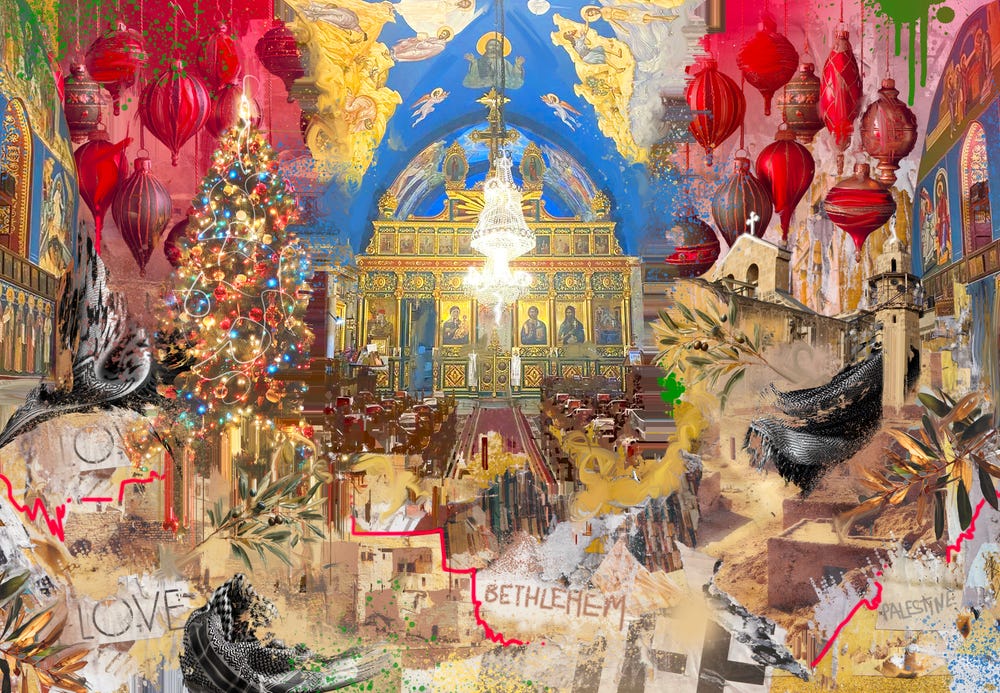
Held by the Land — by Miss AL Simpson
It is one of the quieter accomplishments of Western discourse on Palestine that Palestinian Christians are still treated as an anomaly—something to be discovered, explained away, and then politely ignored. Yet Christianity’s earliest geography is Palestinian: Jerusalem, Bethlehem, and Gaza, with communities that gathered there centuries before Europe became Christian. The disappearance of this history is not an accident of ignorance but a political requirement, produced at the meeting point of Israeli state narrative and Christian Zionist theology. Together, they authorize only two permissible versions of us: absence, or a carefully managed presence. We are a minority, the story insists; Israel protects us from Muslims; our faith arrived with Western missionaries; the Bible mandates our dispossession. The point is not only that these claims are false, but that they are useful; they recast a colonial relationship into a moral tale.
To call Palestinian Christians a minority is not to offer a neutral description; it is to perform an administrative reduction. It turns a people into a category—a remnant to be counted, a fragment to be managed, and, when convenient, displayed as proof of Israeli protection. The word minority does not describe; it assigns us to a role in someone else’s story: the “good” native who proves the occupier’s tolerance, the endangered sect who requires a patron, the exception meant to excuse the rest. It names Palestinian Christians not as we are, in our history and in our ordinary life, but as we are meant to appear—detached from Palestine as a political reality, and reattached to Palestine as a religious spectacle.
This, however, is not how we have ever understood ourselves. We are not a community petitioning for special shelter but are Palestinians—part of the same dispossession, spoken for in the same foreign vocabulary, and asked to survive by agreeing to the terms of our own subordination.
Palestinian Christians are not a minority in the sense that matters. We are part of one people. What binds us to Palestinian Muslims is not only a shared history, but a shared formation—what in Arabic we call akhlaq: the moral grain of a person shaped by household and neighborhood, by the ordinary disciplines of daily life, by an instinctive knowledge of what is owed to family, to a neighbor, to a stranger. This is what the word minority is designed to obscure: not that we share a history, but that we share a soul.
When the Franks invaded—never dignified as “crusaders” in Palestinian memory—Christians were still the largest single group in parts of Palestine. They resisted alongside Muslims. When the Nakba came, being Christian made no difference. Christian and Muslim were expelled together, dispossessed together, erased together. And what followed made no difference either: the same confiscated land and denied permits, the same checkpoints and closures, the same laws written to keep us on the margins of the state that took our country. For Israel, Palestinians have always been one enemy. This, at least, is a truth Israel has understood correctly.
Once the status of minority is assigned, Israel can stage itself abroad as our protector. The claim is designed for export. Israel’s dependence on American evangelical support rests on the carefully cultivated belief that Israel safeguards Christianity in the land of its birth. Remove that image and the theological claim buckles; with it buckles the mass evangelical constituency whose political backing has been converted into policy, funding, and impunity.
The performance and hypocrisy are constant. In late July 2025, at a Christian gathering in Jerusalem, Netanyahu declared that “Israel is the guardian of Christianity in the Middle East.” The following month, Israel’s Jerusalem Municipality froze all bank accounts belonging to the Greek Orthodox Patriarchate—one of the oldest Christian institutions in the world—leaving it unable to pay salaries, maintain schools, or meet basic operating costs.
This freeze on bank accounts followed from the municipality demanding over $190 million in back taxes on 882 church-owned properties, challenging exemptions long treated, under the “status quo,” as continuous from Ottoman practice through the British Mandate, Jordanian rule, and early Israeli administration. As Father Issa Musleh put it, the aim is “to squeeze everything that is Palestinian, Christian, and Muslim, in the Holy Land in order to displace them and push them out.”
Palestinian church leaders now speak openly of what the Rev. Munther Isaac has called “a systematic attempt to empty Jerusalem of its Christian community.” The disappearance of Palestinian Christians would not settle the question of Palestine, but it would provide imperial discourse with the framing it requires: a civilizational confrontation—Islam against Judaism, East against West—with Israel installed as the custodian of values the West congratulates itself for defending. For this fiction to hold, Christianity must be severed from Palestine, emptied of its indigenous continuity, and reassigned to Europe as birthright.
The truth, however, runs in the other direction. Christianity did not travel eastward from the West; it took shape here, in Palestinian towns, languages, and lineages, long before Europe claimed it. We did not convert to a foreign faith; our land and our communities are where that faith was born. Israel, therefore, is not defending Western civilization. It is destroying one of its original sources.
This civilizational framing depends, in turn, on a prior claim: that Jews were “there first,” and that Palestinian presence—Christian or Muslim—came later. But the division that hardened into Judaism and Christianity began as a disagreement within a single people, not as an encounter between separate nations. The earliest Christians were Jews who came to believe that Jesus of Nazareth was the awaited Messiah. Centuries later, when Islam came, many of these same families embraced it. Genetic studies confirm what the history already suggests: Religions changed; the people did not. Judaism precedes Christianity as a religion, but neither precedes the people of this land. As a people, we never left.
Many Western churches have adopted this fiction with ease. Viewing Christianity through a European lens, they speak and act as though the faith were born in Rome or Geneva rather than in Bethlehem and Jerusalem. American evangelical delegations travel to “stand with Israel,” and the itinerary is itself a script, one in which the stones, or biblical sites, are visited and the indigenous Christians are not. In early December 2025, more than one thousand American evangelical pastors and Christian influencers attended the Friends of Zion Ambassadors Summit in Israel. As the Rev. Jack Sara, a Palestinian evangelical leader, wrote afterward, they “walked where Jesus walked—but refused to walk beside His followers who are struggling to survive here.”
The logic these delegations follow divides the world into those who bless Israel and those who curse it—no third position, no space for a Christianity that refuses to sanctify Palestinian erasure. John Hagee, founder of Christians United for Israel—the largest pro-Israel organization in the United States—states it with brutal clarity: “The man or the nation that has blessed Israel has been blessed of God, and to the man or the nation that cursed Israel the judgment of God came in spades.” Indigenous Christians cannot appear in this theology except as a problem, because we are believers who are also the dispossessed; and a binary that rewards blessing and punishes “cursing” has no place for Christians who refuse to bless their own eradication.
But what these delegations treat as biblical mandate is not ancient. It was manufactured in 1909, when Cyrus Scofield’s Reference Bible helped make a particular interpretation of scripture a standard in American evangelicalism. In its margins, he inserted notes that taught millions of readers to treat Genesis 12:3 (“I will bless those who bless you…”) as a religious command to support the Jewish colonization of Palestine. That this interpretation had no basis in two thousand years of Christian theology, that it trained readers to read the Old Testament as if the New had not been written—none of this prevented its success. An interpretation drawn entirely from the Old Testament, owing nothing to the teachings of Christ, became, for millions of American evangelicals, simply what the bible says.
After 1948, once the Israeli state was established, Scofield’s notes no longer appeared as interpretation. They appeared as prophecy fulfilled. Jewish sovereignty in Palestine became, for these American evangelicals, not a political claim but a divine requirement—and prophecy, once believed, seeks confirmation in the world. It finds it, sooner or later, in institutions.
Israel supplied it. Its 2018 Basic Law declares that the right to national self-determination is “unique to the Jewish people.” No biblical text demanded this. A Jew born in Brooklyn can invoke this right, while a Palestinian Christian whose ancestors worshipped in Jerusalem before Europe was Christian cannot—cannot return, cannot claim, cannot appeal to a law that has already decided, before any case is heard, that the land belongs to others.
That is the power of discourse: It can turn the indigenous into aliens, transform exile into a permanent condition disguised as legality, and make the dispossessed appear, in the very vocabulary that names them, as interlopers in their own land.
Against this—against the theology, the law, and the long repetition of convenient fictions—only plain statement will serve. We are not a minority. Israel does not protect us, nor have we ever asked it to. Christianity was not imported from the West. Scripture does not command our eradication.
The burden, for Palestinian Christians, lies in the particular cruelty of a faith weaponized against its own people—and in the bitter irony that being Christian permits us to be heard by the very Western Christians who enable our removal, but only so long as we do not speak as Palestinians.
Being Christian does, at times, open doors that remain closed to Palestinian Muslims. In Western discourse, a Palestinian Christian voice is often received as more credible and more familiar—therefore less threatening. But this reception, which presents itself as openness, operates as a filter. The Palestinian Christian is heard so long as what is said confirms what the listener already believes. The moment that voice names dispossession or assigns colonial responsibility, access becomes fragile. It is withdrawn, not because the truth is unclear, but because it has ceased to be useful.
The access, in other words, was never to speech—only to script. And that script has a function. The colonial framework assigns us a role: evidence of Israeli tolerance, proof that the conflict is religious—“Muslim hatred of Jews”—rather than political dispossession. To speak politically is to malfunction, to fail at the role we have been given. This is why articulation is not a privilege granted to us, but a refusal of the role we are assigned.
To say that Israel drove us out is to refuse the status of grateful minority. To say that our churches predate Western missions, that Christian communities gathered in this land while Europe was still pagan, is to refuse the status of relic—to insist that we are not remnants of a vanished past but bearers of a continuity that predates the very traditions now invoked to displace us. To say that the land was never empty, and that no scripture mandates our elimination, is to refuse to be anyone’s biblical alibi. And to insist that we are one people, bound to every Palestinian—Christian and Muslim alike—is to refuse the assignment itself.
The Christian who speaks politically is accused of not really speaking as a Christian. But this is precisely why the speech matters. It introduces something the discourse cannot absorb: a Christianity that indicts Western Christianity and refuses to let love become a word emptied of justice; a people who were in this land before Zionism named its own arrival a return; a unity that cannot be fractured into manageable minorities. The fictions do not rest; they regenerate. And so we must continue to say what should not need saying, to those who have already arranged not to hear it.
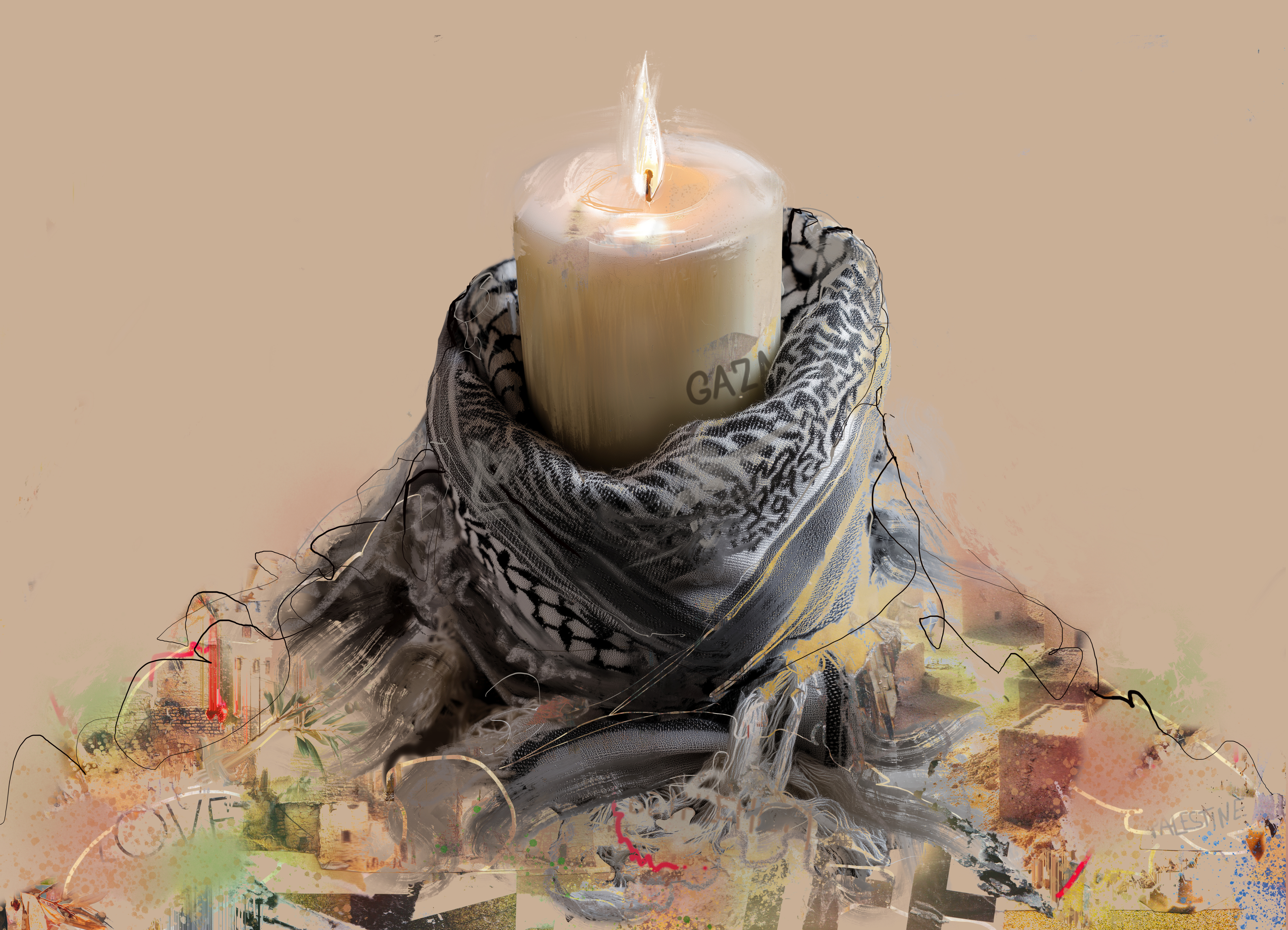
For Alya, on your first Christmas
Palestinian Christians are an inseparable part of Palestine’s history and identity, not a passive minority to be overlooked. We preserve a heritage that predates European Christianity and, alongside Palestinian Muslims, form one people. Telling the truth and resisting distorted narratives is our right, showing that Palestinian identity goes beyond religion—it belongs to justice, continuity, and collective memory.
Thank you for this. The use of our own Bible to colonize our land is one of the most bitter parts of being a Palestinian Christian. Biblical themes pervade almost all my works, as my attempt to reclaim the stolen heritage.