
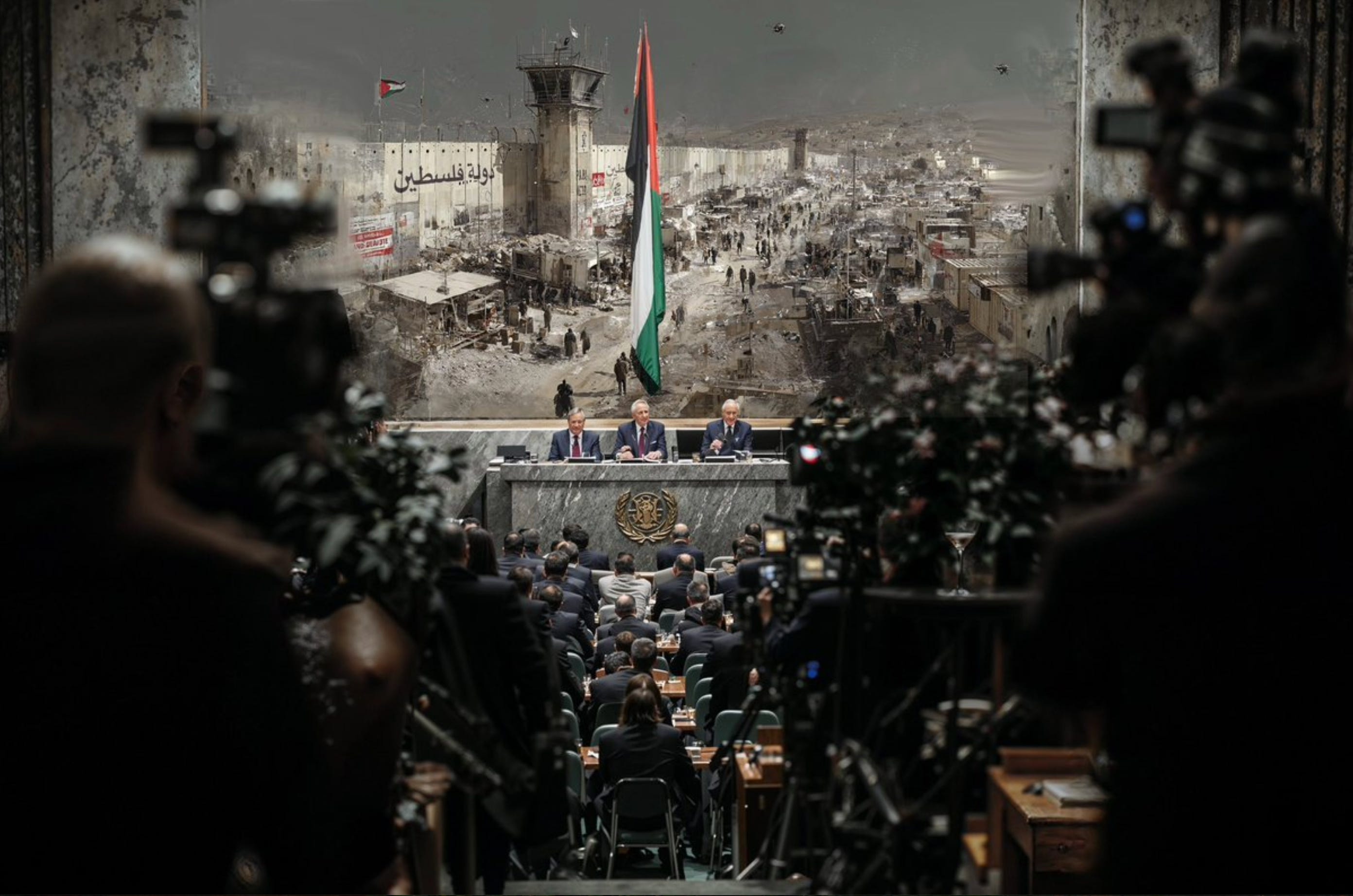
Several Western countries—France, the UK, Canada, and Australia among them—have recognized a Palestinian state at the UN General Assembly. Their governments present the move as a breakthrough for Palestinian rights. The recognitions, however carefully drafted, record something real. Israel’s impunity, once axiomatic, is cracking. But recognition arrives with conditions: demilitarization, governance reforms, and guarantees for Israel’s security. The conditions offer Palestine the form of statehood while denying its substance.
Recognition on these terms is capitulation. It is a pact written by the colonizers to entomb the Palestinian cause under the language of liberation. Demilitarization ensures Israel faces no resistance: Palestinians get a paper state stripped of defense, deemed “viable” only if it protects the state that dispossessed them. Governance reforms install a Palestinian ruling class—domesticated, donor-dependent, and willing to enforce the occupation on Israel’s behalf. In both conditions, what is sacred is the colonizer’s security, and what is forbidden is the colonized’s right to defend themselves.
Most revealing is what the conditions omit: the right of the refugees of 1948 and their descendants to go home. France demanded disarmament, reform, and elections from the Palestinian leadership and prescribed the attributes of the state; it demanded nothing to secure return. The New York Declaration on the Peaceful Settlement of the Question of Palestine and the Implementation of the Two-State Solution—the blueprint the recognizing states adopted at the conference France and Saudi Arabia co-chaired in 2025—concedes return a single passing clause and consigns the “refugee question” to an undefined future framework.
The UN General Assembly endorsed the New York Declaration on September 12, 2025, with 142 votes in favor, 10 against, and 12 abstentions. The recognitions followed nine days later, state by state, on the terms the Assembly had adopted.
A right of return would undo Israel’s founding act. Israel stands on land confiscated from the refugees by a 1950 law that declared them “absentees,” and by a law of the same year that grants a “right of return” to every Jew on earth while denying it to the people it expelled. Disarmament comes first; return may come never.
Taken together, these conditions construct a colonial protectorate to contain the Palestinian liberation struggle. Palestinians would not control borders, currency, or resources. The economy—“economically viable,” in the Declaration’s promise—would live on aid, kept underdeveloped by design. The Declaration spells out the promise release of the Palestinian tax revenues Israel withholds, integration into the global capitalist monetary and financial system, and a program of reconstruction and development. The plan would revise the 1994 Paris Protocol—the annex to the 1993 Oslo Accords that handed Israel control of Palestinian customs, currency, and trade. The United States and Israel oppose it, and it has not been implemented. What remains is a diplomatic road map on paper—and the status quo of occupation on the ground.
Palestinians would count their own population, run their own municipalities, and coordinate with the army encircling them; Israel would still make every decision that matters. Power at that remove needs local hands, and the Palestinian Authority provides the model: a collaborator regime that stages self-governance while legitimizing occupation.
In his 1971 essay “The Specter of the Palestinian State,” Ghassan Kanafani classified such a “state”—formed of the West Bank and Gaza, “instigated, overseen and dominated by Israel”—as “part of the complete surrender to an Israeli military victory.” Its purpose, he wrote, would be “to develop the victor’s military, political and economic superiority.” He was describing a proposal from 1971. He was also describing this one.
A proposal does not survive fifty-four years unless it serves something more durable than diplomacy. Colonialism has always had two answers to a native people who refuse to disappear: contain them or remove them. Containment is the first—the answer the United States gave with the reservation and South Africa with the Bantustan—. It is Europe’s formula for Palestine: endorsed by 142 states at the General Assembly, but written and driven by the capitals that armed Israel. It freezes Israeli sovereignty at the 1967 lines. It offers a disarmed pseudo-state on the remaining 22 percent of historic Palestine—the West Bank and Gaza. The formula might placate publics outraged by the genocide, but it would indisputably secure the spoils of 1948.
The United States, which invented the reservation, now backs the second answer: removal. The settler project wants all of historic Palestine with no Palestinians in it—“transfer,” in Zionism’s own vocabulary. Washington supplies the means and the cover: arms and money for expansion and expulsion, and the veto that shields both from consequence.
Israel treats Europe’s formula as an obstacle to annexation. It races to seize the remnant of historic Palestine reserved for the pseudo-state before any symbolic state can take shape on it. In August, Finance Minister Bezalel Smotrich announced the revival of E1—a settlement project east of Jerusalem that would cut the West Bank in two and sever East Jerusalem from it—and declared that the plan “buries the idea of a Palestinian state.” Israel’s planning authorities then approved 3,401 housing units there. But the speed betrays panic: A state assured of its impunity does not hurry, and Israel is hurrying.
The panic extends to threats against the recognizing states themselves. Prime Minister Benjamin Netanyahu wrote to their leaders accusing them of feeding antisemitism in their own countries—Macron’s call for statehood, his letter charged, “pours fuel on this antisemitic fire”—and gave Paris until the Jewish new year to change course. His foreign minister moved to close the consulate in Jerusalem through which France deals with the Palestinians.
The two colonial answers, so long compatible, now collide: Israel and the United States stand against Europe, and the West splits over the question of Palestine. The state on offer remains a fiction; the recognition of it is a fact, and the fact cuts both ways.
On the one hand, recognition is a trap: A state on the 1967 lines cements the loss of everything stolen in 1948 and abandons the right to justice for the Nakba. It forfeits return and entrenches dependence. The tell is in the drafting: Every recognition of Palestine is written as a re-recognition of Israel. The state France proposes must accept its own disarmament and fully recognize its colonizer. The commitments the recognizing capitals extract run from the Palestinians toward Israel’s security, never the reverse.
On the other hand, recognition is also a step forward. For decades, the United States and Israel have dictated that Palestine does not exist politically—only a “disputed territory” with no right to statehood. Granting political status, even with conditions, breaks that frame. Claims grounded in Palestine’s statehood now are endorsed by some of Israel’s closest allies. The recognizing states thereby forfeit an alibi: The legal grounds for sanctioning Israel’s occupation have existed since 2012, when UN observer status gave Palestine treaty membership and standing before international courts. Recognition strips away one excuse for ignoring them.
Most of the world recognized Palestine long ago—147 of the UN’s 193 member states before September’s wave. Nearly the same number endorsed the New York Declaration. What the wave adds is Israel’s own patrons—France, the UK, Canada, and Australia. Recognition from close Western allies signals that Israel is losing the very capitals it depends on—and that its moral cover is thinning. Israel and the United States fight the wave so fiercely because even symbolic statehood builds momentum. The significance lies less in what materializes on the ground than in what the recognitions expose: the distance between Europe and the United States, between law and power, between Israel’s image and its colonial reality.
Hence the U.S. veto paradox. Europe’s recognition drive seeks to convert managed Palestinian dependence into internationally certified statehood, offering Israel an escape from accountability for the genocide in Gaza. Days before the recognitions, a UN commission of inquiry concluded that Israel is committing genocide, and the Genocide Convention obliges states to prevent it. The recognizing capitals answer that obligation with ceremony while continuing to arm and trade with Israel. Full UN membership of a Palestinian state would give this containment formula its institutional seal, presenting dependency as sovereign equality.
But Washington’s veto of Palestinian membership denies Europe that seal without stopping bilateral recognition. The United States therefore blocks the mechanism meant to bury the question while preserving recognition’s disruptive effects: Israel’s rule appears more plainly as the occupation of a recognized state, the Western alliance divides, and the political excuses for withholding sanctions weaken. In defending annexation, Washington obstructs the containment strategy designed to preserve Israel’s legitimacy—the second answer devouring the first.
There is no victory here for Palestinians; recognition does not restore sovereignty or reverse dispossession. But the process—Europe breaking with the United States over Palestine, Israel baring its settler-colonial nature—matters because it widens the fractures on which Israel’s impunity depends. The recognitions were meant to settle the question of Palestine. Instead, they have reopened it—and a question reopened by the colonizer’s own allies is no longer the colonizer’s to close.
First published September 20, 2025, two days before the recognitions were announced; revised after the vote.
“… the colonized surrender liberation for the right to administer their own subjugation…”
Love your writing. You cut right to the heart of the matter. Precise, clear, unambiguous, and brutally honest.
Thank you for continuing to write.
The point about turning “peace” into a language for managing occupation really stayed with me. A peace process that leaves Palestinian freedom, return, and self-determination unresolved cannot truly be called peace. 🇵🇸