
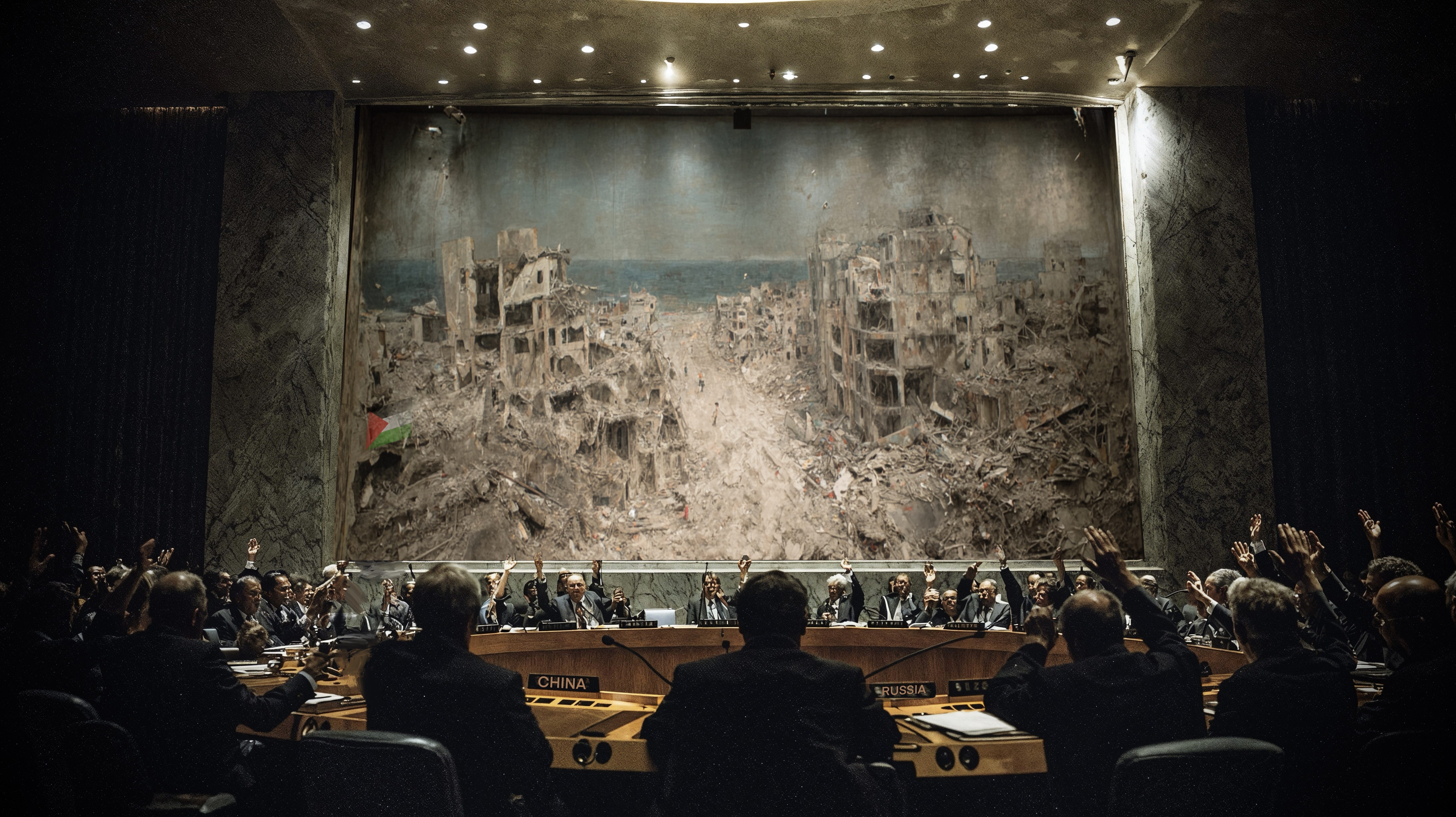
UN - by Norman Harman
Resolution 2803, passed by the Security Council on November 17, 2025, once again asks the world to believe that the United States is the neutral arbiter that will oversee the “pathway” to Palestinian self-determination. It asks us to accept that the very country which has, for the duration of this genocide, supplied Israel with the bombs that have killed over 70,000 Palestinians, shielded Israel from every attempt at international accountability, and sanctioned the International Criminal Court for issuing arrest warrants against Israeli officials, will now preside over a “Board of Peace,” chaired by Donald Trump himself, to decide Gaza’s future.
No one is celebrating. No one, so far as I can tell, believes in this so-called “pathway” at all. That it continues regardless shows that we’ve arrived at a form of politics so debased that even the pretense of credibility has been abandoned. What remains is naked power: arranging the facts on the ground, while the vocabulary of peace provides its cover.
The resolution’s language is horribly revealing in what it both includes and deliberately omits. Nowhere does it reference UNSCR 242 and 338, the foundational texts that established the inadmissibility of acquiring territory by force. Nowhere does it mention the illegality of Israeli settlements, the annexation of Jerusalem, or the systematic dispossession that created the refugee population in the first place. The International Court of Justice’s July 2024 advisory opinion, which affirmed in unambiguous terms that Israel’s presence in the Occupied Territories is unlawful and must end immediately, is passed over in silence, as though it had never been issued. Israel is required to do nothing: no timeline for withdrawal, no end to its assassinations, no halt to settlement expansion on the very land the resolution claims to reserve for Palestinian self-determination.
Instead, UNSCR 2803 “welcomes the constructive role” of the United States, demands the disarmament of Palestinian resistance, and establishes an International Stabilization Force whose purpose, stripped of its euphemisms, is to ensure that Palestinians cannot resist while Israel’s occupation continues. And while this resolution represents an admission that two years of relentless violence failed to accomplish the occupation’s war objectives, its architects now hope to achieve them through the quieter mechanisms of administration. This is a new mandate over Gaza: a two-year American trusteeship that continues the logic of the British Mandate under which Palestine was first fragmented, and Israel created.
Under the Mandate, ceasefires were used not to end violence but to redistribute power: disarming Palestinians while granting Zionist forces freedom of movement under the guise of “restoring order.” Since the latest “ceasefire” began, Israel has expanded restricted zones, obliterated entire families, blocked aid, and denied the wounded evacuation through Rafah. Each violation met with silence, each act demonstrating what the Resolution was designed to permit: total Palestinian compliance while leaving Israel free to evade its commitments. The goal has never been peace. It has always been to make Gaza uninhabitable and force Palestinians into exile. And for those who remain, trusteeship will attempt to achieve what two years of bombardment could not: their complete submission.
The Palestinian Authority, which claims to represent the Palestinian people, has welcomed this resolution with the predictable mixture of exhaustion and misplaced hope that has characterized its posture for three decades now. The drafting, the negotiations, the final text: all of it proceeded without meaningful Palestinian participation. What does it mean to welcome a document that was written about you, without you?
Nor is the PA alone in its accommodation. The arc of imperial policy has long sought to secure Arab compliance with a regional order in which Zionist colonization is treated as legitimate and permanent. Perhaps most dispiriting is the eagerness with which Arab and Islamic states have embraced this arrangement. Qatar, Egypt, the UAE, Saudi Arabia, Jordan, Indonesia, Pakistan, Turkey: All are signatories to a joint statement urging the resolution’s “swift adoption.” These states have watched the destruction of Gaza for over two years; they have witnessed what even the most cautious legal scholars now describe as genocide. Their response is to urge swift adoption of a resolution that rewards the perpetrators with continued control over their victims.
Such complicity requires the right branding. A “Board of Peace” sounds benevolent, even hopeful. An “International Stabilization Force” carries connotations of order restored, chaos contained. A “pathway to statehood” suggests movement, progress, a destination that might one day be reached if only we demonstrate sufficient patience and good behavior. But these are names designed to disguise, not describe.
The Board of Peace will not bring peace; it will administer a territory whose population has endured two years of siege and slaughter, whose infrastructure has been systematically destroyed, whose children—those who survived, that is—will grow up under the authority of the very powers that enabled their suffering. The Stabilization Force will not stabilize; it will suppress. Palestinians are treated as incapable of self-rule, while figures such as Trump and former British prime minister Tony Blair are presented as the administrators equipped to supervise and discipline them.
The pathway to statehood leads nowhere. Before it can even be considered, the PA must reform itself to satisfaction. The resolution does not define the reform program; it borrows it, by reference, from Trump’s own 2020 plan: Rewrite school curricula to adopt the Israeli narrative, recognize Israel as a Jewish state with Jerusalem as its capital, renounce the right of return, and end support for families of prisoners and martyrs. In short, erase Palestinian history and rights as the price of discussing Palestinian statehood. External administration will continue until Palestinians prove themselves worthy of self-governance to the satisfaction of their overseers: ensuring the Board’s control remains indefinite, contingent on Palestinian performance, judged by those who seek to dispossess them, forever.
Francesca Albanese, the UN Special Rapporteur, warns this resolution “runs counter to the Palestinian right to self-determination” and “consolidates Israel’s unlawful presence in the occupied Palestinian territory.” She is correct, and her critique deserves wide attention. But warnings, however principled, change nothing. The international system has issued warnings, passed resolutions, affirmed rights, and expressed concern for 77 years. Yet, the Palestinian people remain stateless, occupied… and in Gaza, two years into a genocide. We have always known that the international system was designed not to liberate the colonized but to domesticate them.
Still, somehow, we are told this resolution is the best that could be achieved under the circumstances, that the alternative was worse, that we must be “pragmatic” and “realistic.” These same arguments were used in defense of the Oslo Accords. We have seen where that pragmatism led: to the entrenchment of settlements, fragmentation of Palestinian territory, transformation of the PA into a subcontractor for Israeli security; and inexorably to the Abraham Accords. Pragmatism without principles is simply capitulation in installments.
What would a genuine resolution look like? It would begin by affirming, without equivocation, that the Israeli occupation is illegal and must end. Not at some unspecified future date, nor contingent on Palestinian “reforms” or “good behavior,” but immediately, as the ICJ has demanded. It would require an end to the killing, the reconstruction of the territory this war has razed, and the establishment of an independent Palestinian state with Jerusalem as its capital.
It would recognize that Palestinian self-determination is unconditional: an inherent right that does not depend on readiness, compliance, or humanitarian need, and cannot be subject to the approval of the occupying power or its allies. It would establish the accountability that the United States has spent two years sanctioning out of existence: for the destruction of Gaza, the decades of dispossession, the systematic violations of international law documented by every credible human rights organization on Earth. And it would ensure that Palestinians themselves are the primary agents of their own future, not objects of decisions made by states whose primary concern is regional hegemony, not justice.
None of this will happen through Resolution 2803. Nor will it do so through the Board of Peace, International Stabilization Force, or a conditional pathway to a state that Israel’s leaders have already declared they will never accept. It will happen, if it does so at all, through the sustained refusal of Palestinians and their allies to accept arrangements that perpetuate injustice in the name of peace. It will happen through the insistence that international law means something; that the rules that govern the behavior of states cannot be selectively applied to protect the powerful while abandoning the weak. It will happen through the cultivation of a political consciousness that sees through all the euphemisms and recognizes that a peace built on the denial of rights is not peace; merely a more sophisticated form of domination.
In the meantime, we are left with a Resolution described by the U.S. Ambassador to the UN as “historic and constructive,” which changes nothing fundamental while providing diplomatic cover for the status quo. The ceremonies will be held, the statements issued, the world will move on to other concerns. And in Gaza, amid the rubble and the grief, a population will awaken each morning to discover that the “pathway” to their freedom has been paved with their own dispossession; that the “peace” on offer is that of the exhausted, the defeated, the subjugated.
This is not the end of anything. It is, as the representative of South Korea noted with unintentional accuracy, “not the end, but a new beginning”—a new beginning of the same old story, told in the same old way. But the ending is not yet written. And when it is, it will not be written by the United States, by Israel, or by the trustees they have appointed over Palestine.

I completely agree. This text accurately shows that Resolution 2803 is not a genuine pathway to Palestinian self-determination, but rather a continuation of the same old pattern in which the fate of the Palestinian people is decided without their presence or consent. When a country that has actively supported Israel militarily and politically is suddenly presented as a “neutral mediator,” the legitimacy of the entire process is undermined.
Ignoring foundational resolutions, the ICJ ruling, and issues like occupation, settlements, and the right of return demonstrates that the primary goal is not peace, but managing the situation in favor of the occupier. The support of Arab states for this arrangement further confirms that maintaining a regional order takes precedence over protecting Palestinian rights. Terms like “Board of Peace” and “Stabilization Force” are merely euphemisms for harsh realities and do not create a real path toward Palestinian independence and sovereignty.
As long as the will and voice of the Palestinian people are not central to decision-making, no diplomatic pathway or resolution can bring true freedom or justice.
A just peace, without drama.
a little emotional reading it